
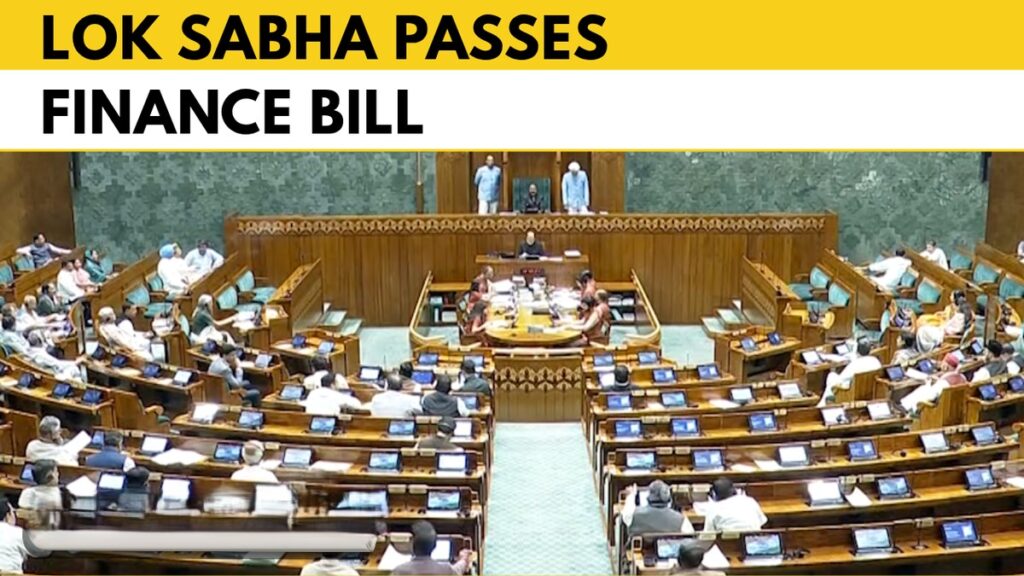
The Lok Sabha on Wednesday approved the Finance Bill 2026, incorporating 32 amendments proposed by the government. With this legislative endorsement, the Lower House has concluded its responsibilities within the broader Budgetary ratification framework. The legislation will now transition to the Rajya Sabha for further consideration. Once the Upper House grants its approval, the comprehensive Budget cycle for the 2026-27 period will reach completion.
32 Amendments in the Finance Bill 2026
The 32 amendments including a 12% surcharge on capital gains from buybacks for individual and corporate shareholders that could make buybacks more expensive. The amendments to the Finance Bill will now be passed by the Rajya Sabha. The flat 12% surcharge is expected to substantially increase the tax outgo for taxpayers as at present there is either nil surcharge on taxable income up to Rs 50 lakh and a 10% surcharge on taxable income between Rs 50 lakh and Rs 1 crore.
The Union Budget 2026-27 presented on February 1 had proposed to tax buyback for all types of shareholders as capital gains. But to disincentivise misuse of tax arbitrage, promoters will pay an additional buyback tax, Finance Minister Nirmala Sitharaman had said. This will make the effective tax 22% for corporate promoters and 30% for non-corporate promoters, she had said.
Missed This?
Why do we anticipate the passing of the Finance Bill 2026?
FM Nirmala Sitharaman says “trust-based tax system at core of Finance Bill 2026“
A tax administration rooted in trust serves as the cornerstone of the Finance Bill 2026, designed to alleviate undue burdens on compliant taxpayers, Finance Minister Nirmala Sitharaman said in the Lok Sabha on Wednesday.
The minister underscored that the administration is guiding the country into a transformative phase of economic management, defined by structural transparency rather than ad-hoc interventions.
Sitharaman stated: “India is moving forward with reform not out of compulsion, which is what has happened earlier, but out of conviction, with clarity, confidence and commitment.” Furthermore, the minister noted that the country is advancing on a path of rapid reform under the stewardship of Prime Minister Narendra Modi, structuring the Finance Bill 2026-27 around five core pillars.
These include enhancing the “ease of living for common citizens and ease of doing business” a move specifically designed to ensure that “people are not burdened by compliances, permits, quotas, and licences for legitimate activities”. The Finance Minister also pointed to the goal of establishing India as a more robust international business destination by providing tax certainty for vital industries such as electronics manufacturing, digital infrastructure, and nuclear power.
She additionally stressed the necessity of fostering fluid trade through extensive customs overhauls aimed at streamlining international logistics. The minister detailed the bill’s focus on “empowering MSMEs, farmers, and cooperatives, which are at the heart of employment generation, production, and overall development”.
Additionally, the Insolvency and Bankruptcy Code (Amendment) Bill, 2025, following its review by the Select Committee, was introduced for deliberation and approval. The finance minister also observed that between 2019-20 and 2024-25, the total expenditure of cesses reached ₹15.14 lakh crore, surpassing actual collections.
Earlier on February 1 in her budget 2026 speech, the Finance Minister introduced several key reforms, while maintaining the same standard deduction and income tax slabs as FY 2025–26. The Budget introduced a new Income Tax Act effective April 1, 2026, with simplified rules and forms for easier compliance. TCS on overseas tour packages and LRS remittances for education and medical purposes has been cut to 2%. The deadline for filing revised returns is extended to March 31, while income tax slabs remain unchanged.
Exploring updates in Corporate Laws?
Read Our Blog Posts on Income Tax Law →