
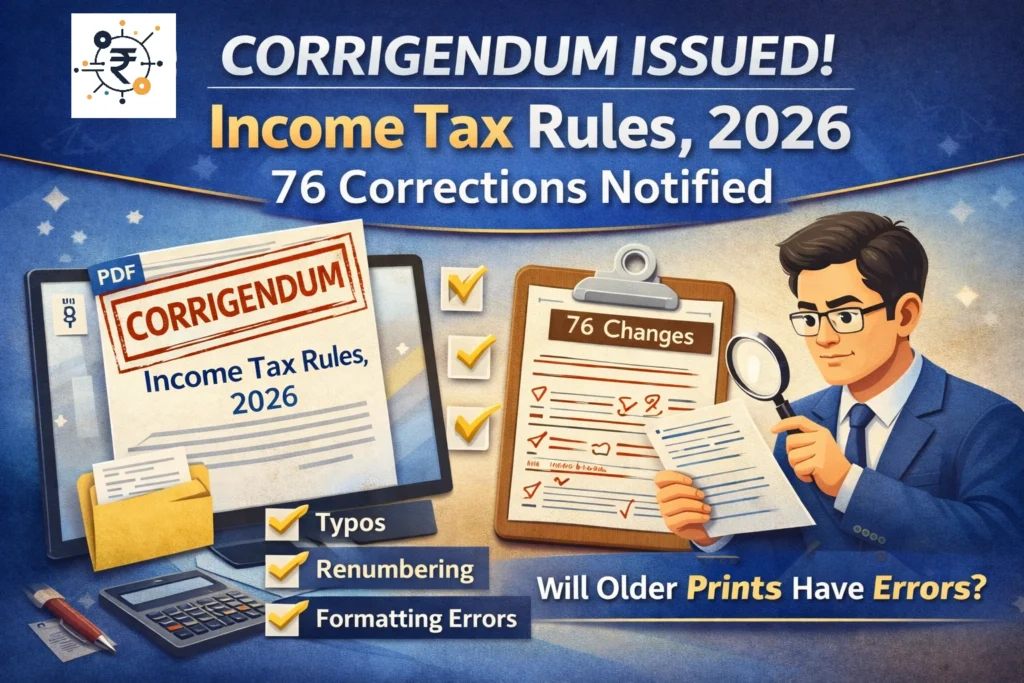
Corrigendum to Income Tax Rules, 2026 – 76 Corrections Notified
In a recent development, the Government has issued a Corrigendum Notification to the Income Tax Rules, 2026, introducing a total of 76 corrections to the previously notified rules.
While at first glance this may appear alarming, the reality is far less dramatic—yet surprisingly insightful into how legislation evolves even after publication.
Download Corrigendum PDF
📜 Background – Original Notification Reference
The corrigendum specifically refers to the earlier notification issued by:
“Government of India, Ministry of Finance, Department of Revenue (Central Board of Direct Taxes), published in the Gazette of India, Extraordinary, Part II, Section 3, sub-section (i), vide number G.S.R. 198(E), dated 20th March, 2026.”
Interestingly, the Income Tax Rules, 2026 were notified even before the Act came into force through publication on 20-03-2025, showcasing the forward-looking approach of the administration.
🤔 What is a Corrigendum?
Think of a corrigendum as the legal system’s way of saying: “Let’s fix what slipped through the cracks.”
A corrigendum is an official correction issued to amend errors in a previously published document. These errors may include:
- Typographical mistakes
- Incorrect references or cross-references
- Numbering inconsistencies
- Formatting or drafting oversights
It does not introduce new law, but rather ensures that the existing law is accurately represented.
In essence, a corrigendum is the statute book quietly straightening its tie before stepping into the courtroom.
🔍 Nature of Changes – 76 Corrections
The corrigendum introduces 76 changes across the Income Tax Rules, 2026. A closer look reveals that:
- Many changes are purely typographical
- Some involve renumbering of rules or clauses
- A few corrections appear unavoidable and logical
- Some, however, may leave readers wondering how they passed initial scrutiny
It’s a mix of precision and human fallibility—a reminder that even in legislation, perfection is often iterative.
After all, to err is human… even in the Gazette of India.
📚 Impact on Printed Publications
This corrigendum raises a practical concern for professionals and students alike.
Leading publishers such as Taxmann and Commercial have already released their printed editions of the Income Tax Act, 2025 and the Income Tax Rules, 1962 (aligned with new developments).
Given the timing of the corrigendum:
- These printed books may not reflect the corrected version
- Users relying solely on physical copies may miss updated references
- Cross-referencing errors could persist in practical use
For professionals who take pride in working with the most updated legal text, this may feel like having a nearly perfect puzzle—with a few pieces subtly out of place.
⚖️ Does This Change Anything Materially?
The reassuring answer is: No, not materially.
The corrections are largely cosmetic and structural rather than substantive. They do not alter:
- Core tax principles
- Compliance requirements
- Interpretation of law in a significant way
However, for litigation, advisory, and academic precision, even small corrections matter.
Because in taxation, sometimes a misplaced word can carry the weight of interpretation.
🧠 Practical Takeaway for Professionals
- Always refer to the latest corrigendum along with the original rules
- Maintain a digital copy of updated statutes
- Be cautious while citing rule numbers in professional work
- Cross-check references in case of ambiguity
In a field where precision is currency, staying updated is not optional—it is essential.
💭 A Closing Thought
Law is often perceived as rigid, unchanging, and absolute.
But moments like these reveal a different truth—law is also a living document, shaped, corrected, and refined over time.
The corrigendum may not rewrite the rules, but it reminds us of something deeper:
Even the most structured systems evolve… one correction at a time.
🚀 TaxRoutine Premium is Now Live
Unlock deeper insights, premium formats, and advanced tax tools.
Plans starting at just Rs. 25/week.
👉 Explore Premium MembershipStay updated. Stay precise. Because in taxation, details don’t just matter—they define outcomes.