
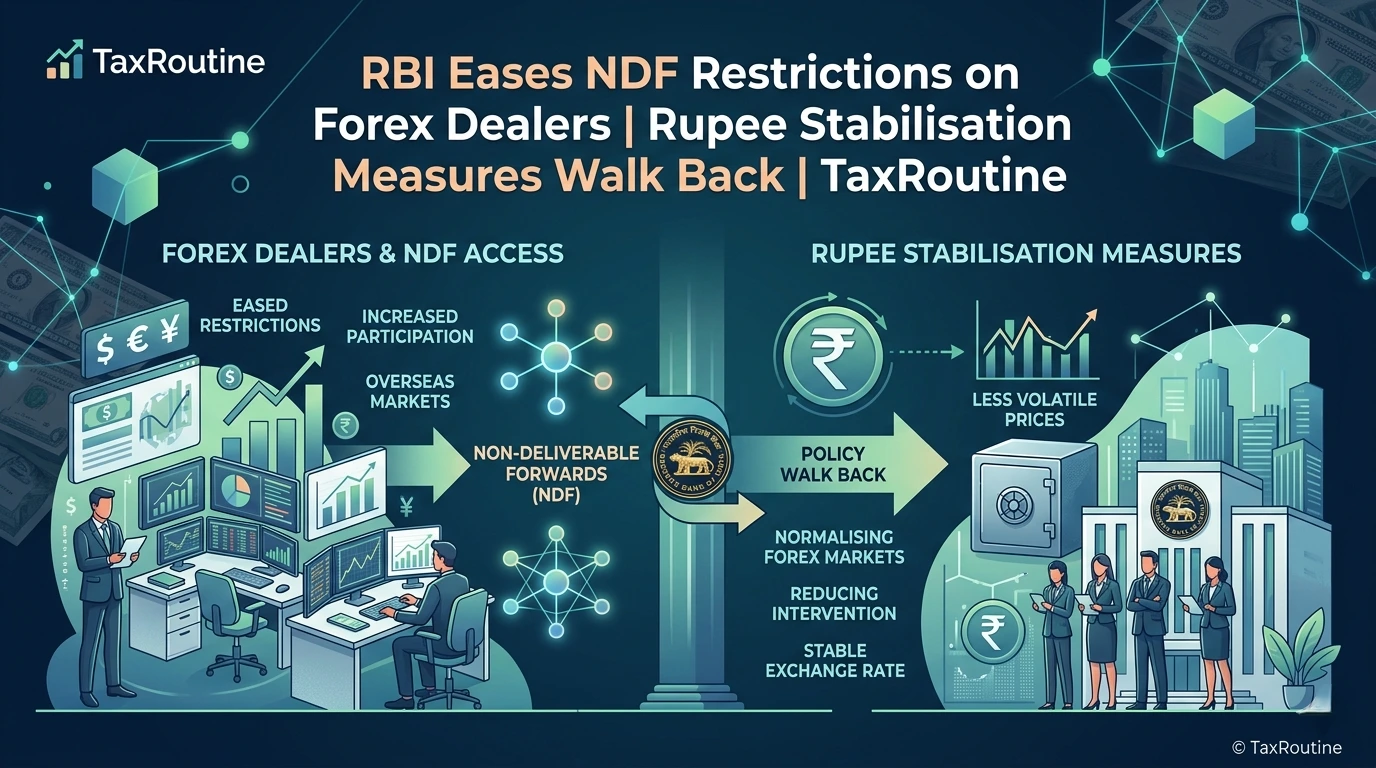
RBI Lifts Key NDF Restrictions on Forex Dealers — Rupee Stabilisation Measures Partially Rolled Back
Three weeks after clamping down on speculative positions in the offshore non-deliverable forwards market, the Reserve Bank of India has eased restrictions on authorised dealers — signalling that its emergency currency-defence playbook is being wound down.
Key Highlights
- Authorised dealers can now offer non-deliverable derivative contracts (NDFs) involving the rupee to both resident and non-resident users.
- Users may once again rebook cancelled foreign exchange derivative contracts involving the rupee.
- The ban on rupee-denominated forex derivative contracts with related parties remains in force, with limited exemptions.
- The $100 million daily net open position (NOP) cap in the onshore deliverable rupee market continues to apply.
- All changes are effective immediately from April 20, 2026.
What the RBI Has Announced
The Reserve Bank of India on Monday (April 20, 2026) issued a circular partially withdrawing the foreign exchange derivative restrictions it had placed on authorised dealers in late March and early April. The central bank said that authorised dealers shall no longer be required to restrict the offering of non-deliverable derivative contracts involving the rupee to resident or non-resident users. They are also now permitted to allow a user to rebook any foreign exchange derivative contract involving the rupee.
Crucially, however, the RBI has not done a full U-turn. Authorised dealers will still be prohibited from entering into rupee-denominated foreign exchange derivative contracts with related parties. The only exemptions to this restriction are the cancellation or rollover of already-existing contracts, and back-to-back transactions conducted with non-related, non-resident users.
The $100 million limit on banks’ net open positions in the onshore deliverable rupee market, imposed on March 27, also stays in place. Banks must continue to maintain their net open positions within this cap at the end of each business day.
“These measures are a reaction to specific market movements and do not signal any structural change. The RBI remains committed to broadening and deepening these markets and to the internationalisation of the rupee.”
— RBI Governor Sanjay Malhotra, April 8, 2026 post-MPC briefingThe Timeline: What Led Here
The NDF crackdown unfolded in stages. In late March, Brent crude surging past $100 a barrel on the back of a worsening US-Iran conflict sent the rupee into a free-fall, pushing it to a record low of ₹95.21 against the US dollar. Speculative positions — particularly in the arbitrage between the onshore deliverable market and the offshore NDF market — were amplifying the slide.
The RBI’s initial response, on March 27, was to cap banks’ net open rupee positions at $100 million in the onshore market, replacing a much looser internal limit linked to Tier-I capital. But that move was partially neutralised: when banks reduced their own positions, corporates stepped in to exploit the spread between onshore and offshore pricing, pushing the onshore-offshore basis spread from a typical range of 1–5 paise to over one rupee at its peak.
On April 1, the central bank issued a sharper circular, effective immediately, barring authorised dealers from offering rupee NDF contracts altogether and prohibiting rebooking of cancelled derivative contracts. The effect was pronounced: the rupee posted its largest single-day gain in roughly 12 years on April 2, closing at around ₹93.10 from a record low of ₹95.22.
At its bimonthly Monetary Policy Committee meeting on April 8, Governor Sanjay Malhotra said the curbs were a response to specific market developments — namely, speculative positions being built in the arbitrage market — and signalled that the restrictions would not remain in place indefinitely. Today’s announcement is the follow-through on that signal.
| Restriction | Status After April 20 |
|---|---|
| Offering rupee NDF contracts to residents / non-residents | ✔ Lifted |
| Rebooking of cancelled forex derivative contracts involving the rupee | ✔ Lifted |
| Rupee forex derivative contracts with related parties | ✗ Still Prohibited — except cancellation/rollover of existing contracts and back-to-back trades with unrelated non-residents |
| $100 mn daily net open position cap (onshore deliverable market) | ✗ Still in Force |
What Is the NDF Market?
A Non-Deliverable Forward (NDF) is a short-term currency forward contract settled in a hard currency (typically US dollars) rather than the underlying currency. Participants agree on an exchange rate for a future date; on maturity, only the net difference between the contracted rate and the prevailing spot rate changes hands — there is no physical exchange of rupees.
The offshore NDF market for the rupee — centred primarily in Singapore, Hong Kong, and Dubai — processes over $150 billion in daily rupee derivative volumes, compared to less than $72 billion onshore. This scale means offshore sentiment can exert significant pressure on the domestic currency, especially when arbitrage channels remain open.
For businesses and treasury teams, the NDF market is a legitimate tool for hedging rupee exposure when deliverable forward contracts are unavailable or restricted — for instance, for non-resident entities that cannot hold rupee accounts. The April 1 ban effectively closed this hedging route, raising costs for genuine hedgers alongside speculators.
Implications for Businesses and Treasurers
The partial rollback restores operational flexibility for corporate treasury teams that had been left without an offshore hedging route since April 1. Firms with foreign currency exposures — importers, exporters, and those with overseas borrowings — can once again use rupee NDF contracts through their authorised dealer banks to hedge positions that cannot be covered through onshore deliverable forwards alone.
The retention of the related-party ban, however, means intra-group forex derivative transactions involving the rupee remain curtailed, which could affect treasury centralisation models used by multinational groups with Indian subsidiaries. Groups relying on back-to-back hedging structures will need to verify that their counterparty qualifies as a non-related, non-resident user under the carve-out.
The $100 million NOP cap, meanwhile, continues to act as a structural constraint on bank positioning. Analysts have noted that as long as this cap remains, the full arbitrage channel between onshore and offshore markets will not fully re-open, giving the RBI a residual degree of control over speculative activity even with the NDF restrictions lifted.
RBI’s Broader Position on Rupee Internationalisation
Monday’s circular aligns with the RBI’s stated long-term objective of internationalising the rupee and deepening India’s currency derivative markets. The central bank has been progressively expanding NDF market access since a 2016 task force recommended permitting residents to transact in the offshore segment. The March–April emergency curbs were explicitly framed as a temporary deviation from that trajectory, not a strategic reversal.
The unwinding of nearly $40 billion in speculative NDF trades following the initial crackdown — and the rupee’s rebound from ₹95.21 to around ₹92–93 levels — appears to have given the central bank enough confidence to ease the emergency posture. The question for markets now is whether that rebound can hold once structural pressures from elevated oil prices and current account dynamics reassert themselves.