
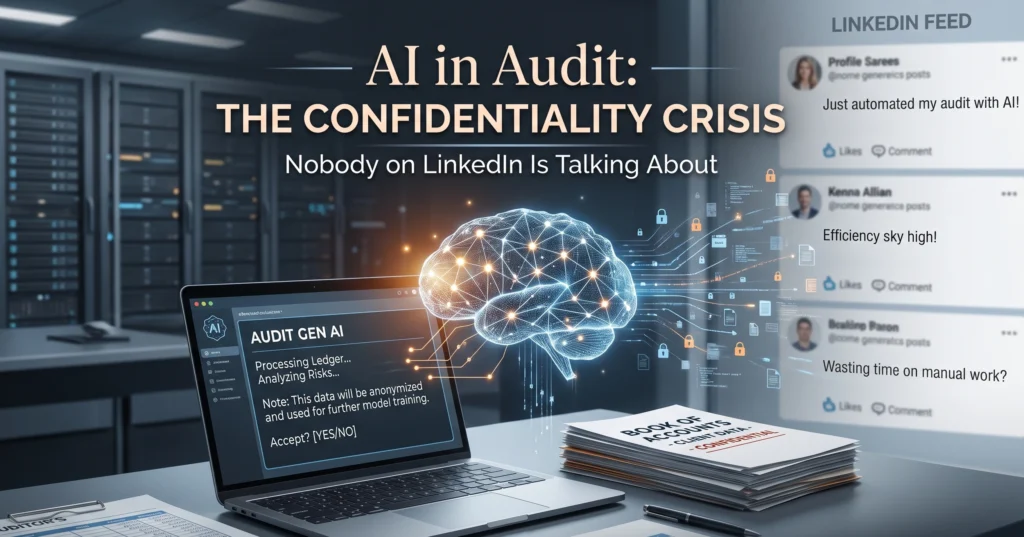
Feeding Your Client’s Books to an AI: The Confidentiality Crisis Nobody on LinkedIn Is Talking About
Scroll through LinkedIn on any given morning and you’ll find a CA or finance professional proclaiming the death of manual audit. The posts follow a predictable script: “I uploaded three years of books to an AI. It found every discrepancy in 4 minutes. Human auditors, your time is up.”
The enthusiasm is understandable. AI tools are genuinely powerful. Pattern recognition across large datasets, instant variance analysis, anomaly flagging — these are real capabilities. But embedded inside every such viral post is a deeply troubling assumption: that feeding a client’s financial data to a third-party AI platform is acceptable, consequence-free, or somehow “just like using Excel.”
It is not. And as Chartered Accountants, the consequences — professional, legal, and ethical — fall entirely on you.
First: What Does “Giving AI Access to the Books” Actually Mean?
When a CA uploads a client’s ledger export, trial balance, or bank statements to a commercial AI platform — whether that is ChatGPT, Claude, Gemini, or any similar tool — the following happens in technical reality:
Data Leaves Your Control
The moment you upload a file or paste data into a chat interface, that data is transmitted to the AI company’s servers — typically located outside India, in the United States or Europe.
It Enters Their Infrastructure
The data is processed, stored (even temporarily), and potentially used in ways governed by the AI company’s own privacy policy and terms of service — not your engagement letter with the client.
You Have No Audit Trail
You cannot certify where the data went, who at the AI company may have accessed it, or whether it will be used to train future models, unless you have a specific enterprise agreement stating otherwise.
The Professional Violations: What the ICAI Says
The Institute of Chartered Accountants of India has a clear and longstanding position on client confidentiality. This isn’t a grey area — it is one of the fundamental principles of the CA profession.
The Code of Ethics for Chartered Accountants (ICAI) — aligned with IESBA’s Code of Ethics — establishes confidentiality as a fundamental principle. A CA shall not disclose confidential information acquired as a result of professional and business relationships to third parties without proper and specific authority or unless there is a legal or professional right or duty to disclose.
An AI platform is unambiguously a “third party.” Let’s walk through each specific violation category:
Breach of Fundamental Principle of Confidentiality
Under the ICAI Code of Ethics, disclosing client financial data to any entity outside the engagement — including technology vendors without proper data processing agreements — constitutes a breach of the confidentiality principle. The “disclosure” happens the moment data is uploaded, regardless of whether anyone at the AI company actually reads it.
No Client Consent in the Engagement Letter
Standard audit engagement letters do not contemplate third-party AI platforms as sub-processors. Unless your client has explicitly consented in writing to their financial data being processed by a named AI vendor, uploading their books constitutes an unauthorized disclosure. “I thought it would help” is not a defence before the ICAI Disciplinary Committee.
Digital Personal Data Protection Act, 2023 Exposure
India’s DPDP Act, 2023 applies to the processing of digital personal data. Client books often contain personal data — names of employees, directors, debtors, creditors, salary details. Transferring this data to a foreign-based AI platform without a lawful basis and, where applicable, without a Standard Contractual Clause-equivalent arrangement, creates direct liability for the data fiduciary — which is you.
Potential Violation of the Companies Act and SEBI Regulations
For listed companies and those under SEBI jurisdiction, Unpublished Price Sensitive Information (UPSI) rules under SEBI (PIT) Regulations, 2015 are directly relevant. Financial data in books of accounts can constitute UPSI. Feeding such data to an external platform — even accidentally — could trigger insider trading-related inquiry not just for the client, but for the auditor.
SA 230 — Audit Documentation Integrity
Standards on Auditing SA 230 requires the auditor to maintain complete and accurate documentation of the audit. An AI-generated output with no verifiable methodology, no reproducible process, and no way to establish chain of custody of data cannot be relied upon as a basis for audit conclusions. Using it as your primary analytical tool undermines the very foundation of your working papers.
Cross-Border Data Transfer Risk
Major commercial AI platforms store and process data in servers located outside India. Under India’s evolving data protection framework, cross-border transfers of sensitive personal and financial data require specific safeguards. Consumer-grade AI subscriptions do not provide these safeguards. Enterprise agreements with data residency clauses are a different matter — but that is not what most practitioners are using.
The Technical Limitations of AI in Audit
Even setting aside the legal and ethical issues entirely, the practical limitations of current AI tools make them unsuitable as the primary instrument of an audit — as opposed to a supplementary tool.
Hallucination: AI Confidently States What Isn’t True
Large language models are designed to generate plausible-sounding responses. They are not designed to be factually accurate. In audit contexts, this means an AI can “find” discrepancies that do not exist, or worse, miss ones that do — and present both conclusions with equal confidence. You cannot distinguish a correct finding from a hallucination without doing the manual verification you were trying to avoid.
Context Window Limits Mean Incomplete Analysis
Even the most capable AI models can only process a limited amount of data in a single session (the “context window”). A mid-size company’s full-year books will routinely exceed this. The AI analyses whatever you paste — not the complete picture. Conclusions drawn from a partial dataset are, by definition, partial.
No Understanding of Business Context
An AI has no knowledge of the client’s industry norms, seasonal patterns, related party history, management intent, or prior year findings unless you explicitly provide all of this. Audit risk assessment requires understanding the entity and its environment — SA 315 is not a prompt-engineering problem. An AI flagging a high trade creditor balance has no way to know that this is normal for this particular client’s business cycle.
No Verification of Source Data Integrity
An AI processes whatever you give it. It cannot independently verify that the data you fed it is complete, unmodified, or not manipulated. Audit fundamentally involves tracing entries back to source documents. An AI reading an Excel export cannot tell you whether the underlying vouchers exist, whether approvals were obtained, or whether the data was altered before export.
Professional Judgment Cannot Be Delegated to a Machine
Audit opinion is the exercise of professional judgment. It requires the auditor to weigh evidence, assess management representations, apply materiality, and form an independent view. This is not something that can be outsourced to a language model. The signature on the audit report is yours. The liability for a wrong opinion is yours. The AI bears none of it.
Model Updates Change Behaviour Without Notice
Commercial AI models are updated continuously. The same prompt given to the same AI tool three months apart may produce different outputs. Audit procedures require consistency and repeatability. A tool whose analytical logic changes without documentation or version control is fundamentally incompatible with audit standards.
What the Regulatory Landscape Actually Looks Like
| Framework | Relevant Provision | Risk to CA |
|---|---|---|
| ICAI Code of Ethics | Fundamental Principle of Confidentiality | Disciplinary proceedings, suspension, removal from membership |
| DPDP Act, 2023 | Processing personal data without lawful basis; cross-border transfer without safeguards | Penalty up to ₹250 crore per breach under proposed rules |
| SEBI PIT Regulations, 2015 | UPSI leakage to non-connected parties | SEBI investigation, civil and criminal liability |
| Companies Act, 2013 | Auditor duties and professional responsibility under Sec 143 | Disqualification, NFRA proceedings for listed company auditors |
| SA 230 (Audit Documentation) | Documentation must support audit conclusions | Adverse quality review findings; potential audit opinion challenge |
| IT Act, 2000 / Sec 43A | Negligent handling of sensitive personal information | Compensation liability to affected individuals |
So Is AI Useless in Audit? No — But Context Matters
This is not an argument against AI in audit work. AI genuinely can assist with drafting audit programmes, structuring working papers, reviewing publicly available financial disclosures, researching accounting standards, generating checklists, and processing anonymised or synthetic data for training purposes.
The distinction that matters is this:
Using AI as a thinking tool (acceptable) is fundamentally different from using AI as a data processor for confidential client information (not acceptable without appropriate safeguards). The former augments your judgment. The latter transfers your data — and your professional risk — to a third party whose terms of service were not written with audit ethics in mind.
Firms wanting to genuinely integrate AI into audit workflows need enterprise-grade solutions with: data processing agreements, explicit data residency guarantees, no model training on client data, access controls, and audit trails. These exist — but they are not the same as a consumer Claude or ChatGPT subscription.
The LinkedIn Version vs. The Reality
The posts going viral make AI audit sound frictionless, impressive, and career-defining. What they omit:
They Didn’t Ask the Client
In virtually every viral AI-audit post, there is no mention of client consent. The CA made a unilateral decision to upload sensitive financial data to a third-party platform. That is a confidentiality breach regardless of the outcome of the analysis.
They Verified the Output Manually Anyway
Most honest practitioners who use AI analytically still verify findings manually. The AI speeds up the identification phase — it does not eliminate the verification phase. The time savings are real but often overstated.
It Works Until It Doesn’t
AI-assisted analysis that misses a material misstatement — because of incomplete data, a hallucination, or a context gap — exposes the auditor to negligence claims. “The AI said it was fine” will not be a defence before the NFRA or a civil court.
AI will reshape audit work over the next decade. That is certain. But the profession’s response to that change cannot be to quietly discard client confidentiality in the name of efficiency. The CA who uploads client books to a consumer AI platform without consent, without a data agreement, and without understanding the legal exposure is not an early adopter — they are a liability waiting to materialise.
What You Should Do Instead
If you want to use AI in your practice responsibly, here is the minimum standard:
1. Update your engagement letters. Explicitly address whether and how AI tools may be used in the engagement, name any third-party platforms, and obtain written client consent.
2. Anonymise before uploading. Where AI assistance is genuinely needed for analysis, strip all identifying information — entity name, PAN, director names, account numbers — before uploading any data.
3. Use enterprise agreements, not consumer subscriptions. If your firm processes significant volumes of client data, invest in an enterprise AI agreement that includes a Data Processing Agreement (DPA), data residency commitments, and explicit no-training-on-data clauses.
4. Document your AI use in working papers. Note the tool used, the version, the nature of data processed, the output generated, and the independent verification steps taken. AI outputs are not self-evidencing.
5. Keep professional judgment central. AI is a tool. The audit opinion, the risk assessment, the materiality decision, and the judgement on going concern remain yours — and so does every consequence that flows from them.
The profession is at a turning point. How we handle AI adoption in the next few years will define whether the CA designation retains its credibility as a mark of trusted, independent professional judgement — or becomes indistinguishable from any other data-processing service. That choice is made one engagement at a time.