
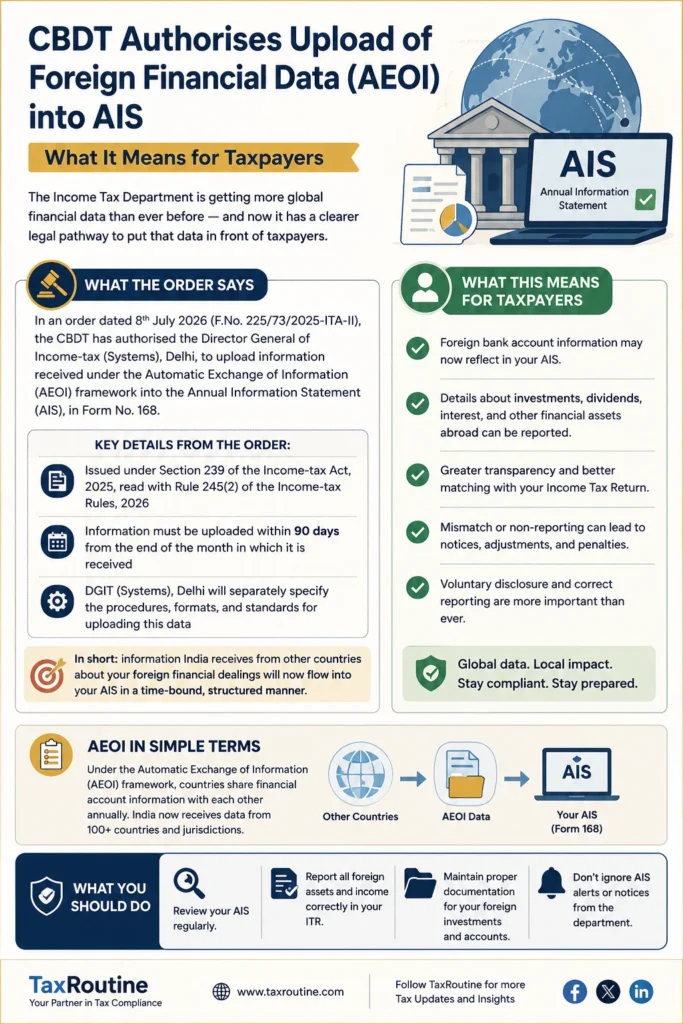
CBDT Authorises Upload of Foreign Financial Data (AEOI) into AIS — What It Means for Taxpayers
Income Tax | AIS & Compliance | Updated July 2026
The Income Tax Department is getting more global financial data than ever before — and now it has a clearer legal pathway to put that data directly in front of taxpayers.
What the Order Says
In an order dated 8th July 2026 (F.No. 225/73/2025-ITA-II), the Central Board of Direct Taxes (CBDT) has authorised the Director General of Income-tax (Systems), Delhi, to upload information received under the Automatic Exchange of Information (AEOI) framework into the Annual Information Statement (AIS), in Form No. 168.
- Issued under Section 239 of the Income-tax Act, 2025, read with Rule 245(2) of the Income-tax Rules, 2026
- Information must be uploaded within 90 days from the end of the month in which it is received
- DGIT (Systems), Delhi will separately specify the procedures, formats, and standards for uploading this data
In short: information India receives from other countries about your foreign financial dealings will now flow into your AIS in a time-bound, structured manner.
What This Means for Taxpayers
- Foreign bank account information may now reflect in your AIS.
- Overseas investments, interest, dividends, and other reportable foreign financial assets will be easier for the Income Tax Department to match against your ITR.
- Cross-border tax compliance is becoming increasingly data-driven, with less room for mismatches to go unnoticed.
Why This Matters
AEOI is the framework under which India exchanges financial account information with partner jurisdictions, largely modelled on the OECD’s Common Reporting Standard (CRS). Until now, this data existed with the tax department but wasn’t always visible to taxpayers in a structured, pre-filled format. With this order, that gap is closing — the same way domestic TDS and SFT data already shows up in AIS today.
What You Should Do
- Review your Schedule FA and Schedule FSI disclosures carefully before filing.
- Cross-check your AIS regularly, not just at the time of filing.
- Reconcile foreign income and asset figures with your actual overseas statements — discrepancies are now easier for the department to flag automatically.
- If you’ve missed disclosures in earlier years, consult a professional about corrective filing options before a mismatch triggers scrutiny.
FAQs
What is AEOI?
Automatic Exchange of Information (AEOI) is an international framework under which tax authorities in different countries automatically share financial account information about each other’s residents, largely based on the OECD’s Common Reporting Standard (CRS).
What has CBDT actually authorised in this order?
CBDT has authorised the DGIT (Systems), Delhi to upload AEOI information already in its possession into the Annual Information Statement, using Form No. 168, within 90 days from the end of the month in which the information is received.
Under which law was this order issued?
The order was issued under Section 239 of the , read with Rule 245(2) of the Income-tax Rules, 2026.
Will my foreign bank accounts show up in AIS now?
Foreign bank account details and other reportable foreign financial information received through AEOI can now be uploaded into your AIS, subject to the procedures and formats that DGIT (Systems) will separately notify.
What should I do if I have foreign income or assets?
Make sure Schedule FA and Schedule FSI in your ITR are complete and accurate, check your AIS regularly, and reconcile it against your actual foreign account statements before filing.
What happens if there’s a mismatch between AIS and my ITR?
A mismatch can trigger scrutiny or notices from the Income Tax Department. As AEOI data feeds into AIS in a structured, time-bound manner, such mismatches are likely to be flagged faster and more systematically than before.
Have foreign bank accounts, overseas investments, or foreign income and want a professional review before you file?
Talk to on WhatsApp