
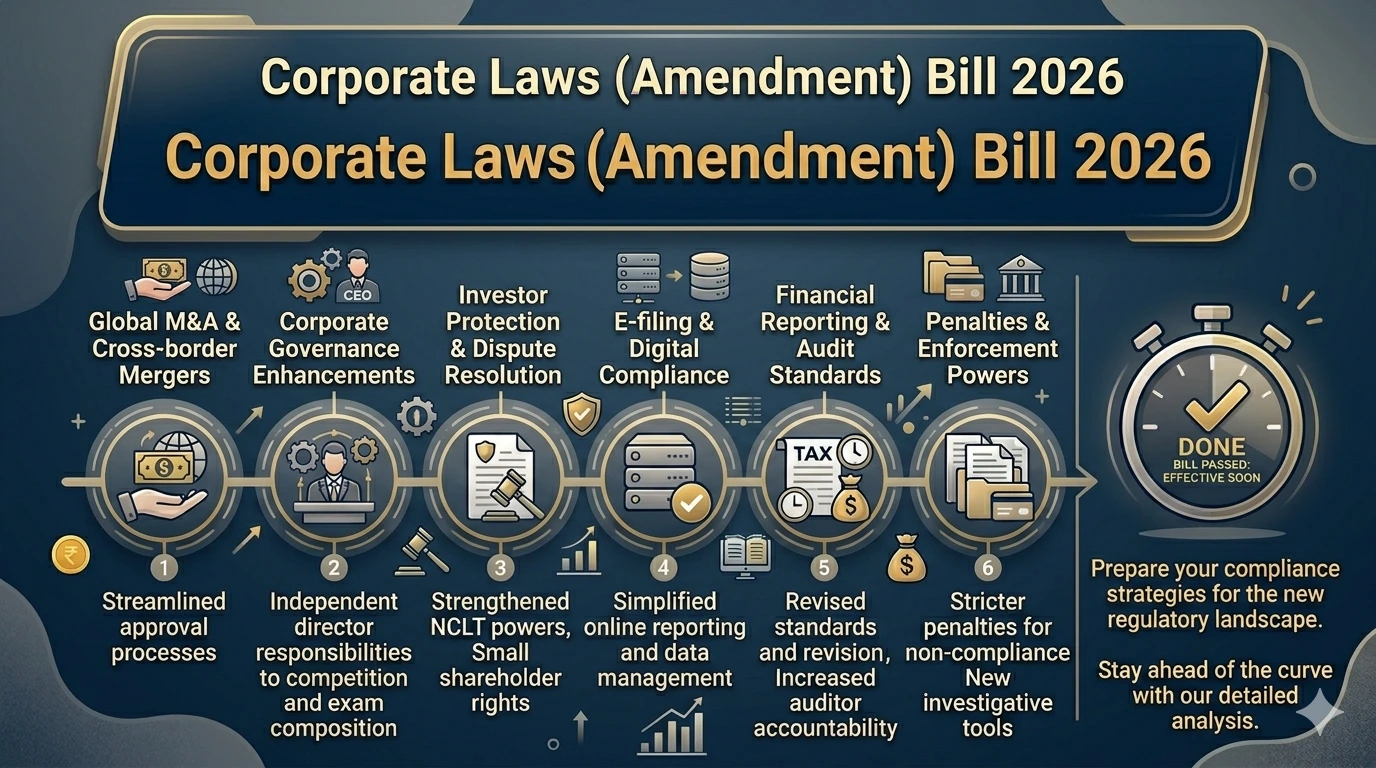
The Corporate Laws ( Amendment ) Bill, 2026 has been introduced in the Lok Sabha with a clear focus on making India’s corporate ecosystem more business-friendly. The proposed changes aim to simplify compliance, introduce greater operational flexibility, and strengthen governance and enforcement mechanisms under the Companies Act, 2013 and the Limited Liability Partnership (LLP) Act, 2008.
These reforms are particularly relevant for companies operating in International Financial Services Centres (IFSCs), smaller businesses, and regulated entities. Below is a clear, structured overview of the key proposals.
Exploring updates in Corporate Laws?
Read Our Blog Posts on Company Law →1. Major Amendments to the LLP Act, 2008
New Definitions for IFSC Operations
The Bill introduces specific definitions for “International Financial Services Centre”, “International Financial Services Centres Authority”, “permitted foreign currency”, and “Specified International Financial Services Centre LLP”. This creates a dedicated framework for IFSC-based LLPs.
Simplified Professional Declarations at Formation
Professionals (advocates, chartered accountants, cost accountants, or company secretaries) will now be required to provide declarations only when they are actually engaged in the formation or incorporation of the LLP. A new proviso also allows Specified IFSC LLPs to state their objects as permitted under the IFSCA Act, 2019.
Registered Office and Naming Requirements for IFSC LLPs
- Specified IFSC LLPs must maintain their registered office within an IFSC at all times.
- They will also be required to include the suffix “IFSC LLP” in their name.
Filing of LLP Agreement Changes for Regulated Entities
For LLPs regulated by SEBI or IFSCA, any changes to the LLP agreement will need to be filed as prescribed by rules — giving regulators more targeted oversight.
Contribution Rules for IFSC LLPs
- Contributions must be accounted for and disclosed in a permitted foreign currency.
- Existing IFSC LLPs will get a transition window (as specified by IFSCA in consultation with the Central Government) to convert rupee-denominated contributions.
- New monetary contributions from partners must be in permitted foreign currency only.
Valuation Rules Aligned with Companies Act
A new Section 33A will apply the valuation provisions of Section 247 of the Companies Act, 2013 (registered valuers) to LLPs for partner contributions, property, assets, net worth, or liabilities.
Lighter Penalty for Non-Compliance with Registrar’s Requests
Failure to comply with a Registrar’s requisition (other than a summons) will now attract a fixed penalty of ₹10,000.
New Route: Conversion of Specified Trusts into LLPs
A new Section 57A will allow conversion of trusts (established under the Indian Trusts Act, 1882 or any Central/State Act and registered with SEBI/IFSCA) into LLPs, subject to the new Fifth Schedule.
Missed This?
How the new CSR threshold will benefit small & medium companies
2. Key Amendments in the Companies Act, 2013
Flexible Meeting Formats (Physical, Virtual & Hybrid)
- Companies can hold AGMs and EGMs in physical, virtual, or hybrid mode, as prescribed.
- If the requisite number of members requisition a hybrid meeting under Section 100(2), the company must comply.
- Every company must still hold at least one physical AGM every three years.
Shorter Notice for Wholly Virtual EGMs
Wholly virtual EGMs (conducted through video conferencing or other audio-visual means) can now be called with just 7 days’ notice (or such other period as prescribed), making urgent decision-making faster.
Stricter Penalties for Maintenance of Books of Account
- Listed companies face a fixed penalty of ₹5 lakh (earlier ₹50,000–₹5 lakh).
- Other companies face ₹50,000.
- Contraventions relating to Section 128(1) or 128(5) attract even higher penalties — ₹25 lakh for listed companies and ₹5 lakh for others.
CSR Threshold Raised for Smaller Companies
The net-profit threshold for constituting a CSR Committee has been increased from ₹5 crore to ₹10 crore (net worth and turnover thresholds remain unchanged). This will significantly reduce compliance burden for mid-sized companies.
Cost Audit – New Standards and Clearer Penalties
- The Central Government can now prescribe Cost Accounting Standards on the recommendation of the Institute of Cost Accountants of India.
- KMPs (MD, WTD in charge of finance, CFO, or any other responsible person) face specific penalties for non-compliance.
- Companies and officers in default will also be subject to graded penalties with daily defaults.
Still confused about the new Cost Audit Penalties?
Get Clear Explanation HereTighter Rules for Independent Directors
- Disqualification now covers relationships in the “current financial year” as well.
- The threshold for professional relationships (legal/consulting firms) with the company has been lowered to a prescribed percentage, allowing stricter independence standards.
Director Eligibility & Tenure
- A director’s DIN must remain active for both appointment and continued directorship.
- Additional directors will have a fixed tenure — up to the next general meeting or three months from appointment, whichever is earlier.
- New disqualification grounds: acting as auditor, secretarial auditor, cost auditor, registered valuer, or insolvency professional of the company (or its group) in the preceding three years or current year; and not being assessed as a “fit and proper person” by the Board.
Penalty for Breach of Directors’ Duties
A new penalty provision under Section 166 (other than sub-section 5) — ₹5 lakh for listed companies and ₹2 lakh for others.
Relief for Small Companies, OPCs & Dormant Companies
Only one Board meeting per calendar year will now be required (instead of two with a 90-day gap).
Simplified Resignation for Non-Director KMPs
Whole-time KMPs who are not directors can resign by giving written notice. The Board must acknowledge it and inform the Registrar; failing which the KMP can directly file the resignation with the Registrar.
Mandatory Disposal of Pre-2013 Treasury Shares
Companies holding shares in their own name or through trusts under old pre-2013 arrangements must dispose of them within three years. Failure will lead to cancellation of shares and daily penalties.
Improved Processes for Striking Off, Restoration & Winding Up
- Clearer illustrations and procedural rules for striking off inactive companies.
- Regional Directors can now handle restoration applications (reducing Tribunal burden).
- Expanded eligibility for Company Liquidators (including insolvency professionals) and a new appeal mechanism against Central Government orders.
Producer Companies
- Timelines for AGMs clarified.
- Mandatory internal audit for Producer Companies with average annual turnover above ₹5 crore (or prescribed limit) for three consecutive years.
Stronger Adjudication, Recovery & Settlement Framework
- “Adjudicating Officer” (not below Assistant Registrar rank) will handle penalties.
- New sections provide structured recovery (including attachment of property) and settlement mechanisms.
- Dormant company provisions tightened — eligible companies “shall” apply for dormant status, and the definition of inactive company is widened.
Why These Changes Matter
The Bill strikes a balance between ease of doing business and stronger accountability. Virtual/hybrid meetings, higher CSR thresholds, simplified KMP resignation, and IFSC-specific rules will benefit companies of all sizes. At the same time, stricter penalties, clearer disqualification norms, and robust recovery mechanisms aim to improve governance and deter non-compliance.
These reforms are expected to reduce regulatory friction, attract more investment into IFSCs, and modernise corporate compliance in line with global best practices.