
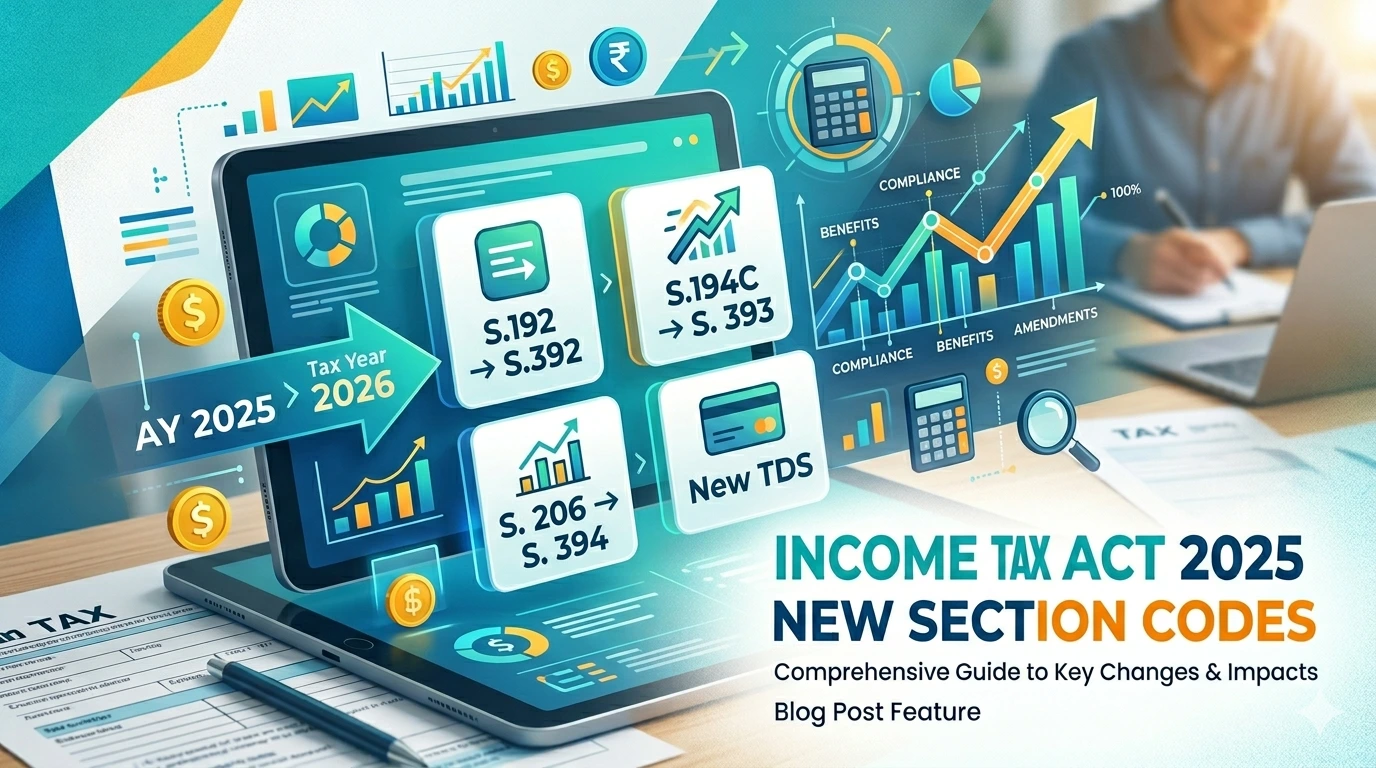
New TDS/TCS Payment Sections:
69 Sections Become 3.
India’s most radical overhaul of tax withholding law in 60 years is live. Here is your complete guide to the new payment Sections under the Income Tax Act, 2025 — and exactly what changed from the 1961 Act.
From April 1, 2026, all TDS/TCS challan payments and returns must quote section numbers from the Income Tax Act, 2025 — not the 1961 Act. Wrong section codes = defective returns, penalties, and compliance headaches. Read this before your next payroll or vendor payment.
The Law Every Accountant, Business Owner, and HR Manager Must Read Right Now
If you’ve been deducting TDS for years, you probably know sections like 192, 194A, 194C, 194H, and 194J by heart. You’ve memorised limits, cross-referenced Finance Act amendments, and wrestled with overlapping provisions every quarter. That ends — mostly — from April 1, 2026.
The Income Tax Act, 2025 is the first complete rewrite of India’s direct tax law since 1961. And at its heart is a radical simplification of TDS and TCS: what took 69 sections and 27,452 words now takes just 3 sections and 14,675 words.
But simplification doesn’t mean “nothing changes operationally.” Payroll systems need new section codes. TDS challans will reference different section numbers. Return preparation utilities are being updated. Get it wrong, and your TDS return becomes defective.
From a 69-Section Maze to a 3-Section Map
Under the Income Tax Act, 1961, TDS provisions sprawled across sections 192 to 194T — each section covering a specific payment type with its own threshold, rate, exemption rules, and penalty clause. The result? A compliance nightmare that required specialists to navigate.
The Income Tax Act, 2025 tears this up and replaces it with a clean tabular structure:
TDS on Salary
Covers all salary payments and EPF withdrawals exceeding ₹50,000. Replaces Sections 192 and 192A of the old Act.
TDS on All Other Payments
The mega-section. Replaces 67 separate TDS sections — from interest to rent to professional fees — through structured tables for Residents, Non-Residents, and Others.
TCS — All Collections
Consolidates all Tax Collected at Source provisions. Same rates and thresholds as the old Act but in a single, clean structure.
Section 393 alone uses three internal tables — one for Residents, one for Non-Residents, and one for Any Person. Each table specifies the nature of payment, monetary threshold, who deducts, and the applicable rate. It is structured like a lookup table, not legislation.
Section 392, 393 & 394: What Each One Actually Covers
Section 392 — TDS on Salary (replaces 192 & 192A)
Employers must continue deducting TDS on salary at applicable slab rates. The significant addition: Section 392 now explicitly includes EPF withdrawals exceeding ₹50,000 under the same section, at a 10% TDS rate. Previously, Section 192A handled EPF separately. Now it’s unified.
Section 393 — TDS on Non-Salary Payments (replaces 193–194T)
This is the big one. Everything that isn’t salary — dividends, interest, rent, contractor payments, professional fees, brokerage, lottery winnings, virtual digital assets — falls here. Instead of hunting across 67 different sections, you look up a table:
- Table A: Payments to Residents
- Table B: Payments to Non-Residents (replaces old Section 195 etc.)
- Table C: Payments to Any Person (irrespective of residency)
Importantly, advertising services — previously covered under Section 194C at 1-2% — have been realigned. They now fall under professional services in Section 393, attracting a 10% TDS rate. Businesses paying ad agencies: take note.
Section 394 — TCS (replaces 206C)
All Tax Collected at Source provisions are now consolidated under Section 394. The framework is identical — the seller/collector deducts at source before transferring consideration — but the citation code changes entirely.
If your business pays advertising agencies, the TDS rate jumps from 1-2% (old 194C) to 10% (new Section 393) because advertising is now classified under “professional services.” Review your payment workflows urgently.
Old vs New: Side-by-Side Payment Code Reference
Here is the definitive cross-reference table. Bookmark it. Print it. Share it with your accounts team.
| Payment Type | Old Act (1961) — Section | New Act (2025) — Section |
|---|---|---|
| Salary | 192 | 392 Same Rate |
| EPF Withdrawal (>₹50,000) | 192A | 392 (merged) Merged |
| Interest on Securities | 193 | 393(1)[Table: S.No. 5(i)]Same Rate |
| Dividends | 194 | 393(1)[Table: S.No. 7] Same Rate |
| Interest (Banks, FDs, etc.) | 194A | 393(1)[Table: S.No. 5(ii) & 5(iii)]10% | Same |
| Winnings (Lottery, Crossword) | 194B | 393(3)[Table: S.No.1] 30% | Same |
| Contractor Payments | 194C | 393(1)[Table: S.No. 6(i)] 1-2% | Same |
| Insurance Commission | 194D | 393(1) — [Table: S.No.1(i)] Same Rate |
| Rent (Land, Building, Plant) | 194I | 393(1)[Table: S.No. 2(i) & 2(ii)] 10%/2% | Same |
| Professional / Technical Fees | 194J | 393(1)[Table: S.No. 6(iii)] 10% | Same |
| Advertising Payments | 194C (1-2%) | 393(1)[Table: S.No. 6(iii)] ⚠️ Now 10% |
| Commission / Brokerage | 194H | 393(1)[Table: S.No. 1(ii)] Same Rate |
| Immovable Property Transfer | 194IA | 393(1)[Table: S.No. 3(i)] 1% | Same |
| Virtual Digital Assets | 194S | 393(1)[Table: S.No. 8(iv)] 1% | Same |
| E-commerce Payments | 194O | 393(1)[Table: S.No. 8(v)] Same Rate |
| Partner Salary/Remuneration | 194T (from 2024) | 393(3)[Table: S.No. 7] 10% | Same |
| Non-Resident Payments | 195, 196A-196D etc. | 393(2)[Table: S.No.10-15], 393(5) Consolidated |
| TCS — Scrap / Minerals / Liquor | 206C(1) | 394,395,398 1-5% | Same |
| TCS — Motor Vehicles >₹10L | 206C(1F) | 394 1% | Same |
| TCS on Goods Sold >₹50L | 206C(1H) | REMOVED from Apr 2025 |
| Higher TDS for Non-Filers | 206AB / 206CCA | REMOVED |
| TCS — LRS Remittances | 206C(1G) — ₹7L threshold | 394 — ₹10L threshold Limit Raised |
Three Big Deletions That Will Simplify Your Life
1. Section 206C(1H) — TCS on Sale of Goods
Sellers who received more than ₹50 lakh from any buyer had to collect TCS at 0.1%. The problem: Section 194Q already required the buyer to deduct TDS on the same transaction. Double compliance on the same deal. This has now been scrapped. From April 2025, sellers no longer collect TCS on goods.
2. Sections 206AB & 206CCA — Higher Rates for Non-Filers
These required deductors and collectors to check whether their counterparty had filed income tax returns, and if not, apply double or higher rates. In practice, this meant running ITR verification checks on every vendor, customer, and contractor. Operationally painful, and removed entirely.
3. Prosecution Risk Under 276BB — Softened
Previously, delayed TCS deposit could trigger criminal prosecution leading to 3-7 years in prison. The new Act says: if you deposit before the quarterly TCS return due date, prosecution will not be initiated. A meaningful relief for businesses with genuine cash flow delays.
4. How do I get the threshold limit under each section?
The threshold limits under which TDS need not be deducted and cases where TDS need not be deducted are mentioned under Section 393(4) of the Income Tax Act, 2025 and table thereunder.
Did TDS/TCS Rates Actually Change?
Short answer: Almost entirely unchanged. The Income Tax Act, 2025 is primarily a structural simplification exercise. Key rates remain:
- Interest income (FDs, Securities): 10% — unchanged
- Rent (Land/Building): 10% — unchanged
- Professional / Technical fees: 10% — unchanged
- Contractor payments: 1-2% — unchanged
- TCS on Motor Vehicles >₹10L: 1% — unchanged
- Virtual Digital Assets: 1% — unchanged
- Advertising services: Now 10% (was 1-2%) Changed
Exact rates for certain payment types (like insurance commission) are still referenced to the applicable Finance Act for that tax year, not hard-coded in the 2025 Act itself. For AY 2027-28, refer to Finance Act 2026. The structure separates the framework (Income Tax Act) from the rates (Finance Act) more clearly than before.
How the Cutover Works: The Critical Dates
The transition is clean — the dividing line is the date of payment or credit, not the date of contract or invoice.
Old Act Governs
Any sum paid or credited on or before this date follows Income Tax Act, 1961 provisions. Quote old section numbers (194C, 194J, 206C etc.) in challans and returns.
New Act Takes Over
All payments from this date onward are governed by Income Tax Act, 2025. Quote Section 392, 393, or 394 with the relevant table item in all TDS/TCS challans and returns.
Dual-Mode Returns Supported
The TDS Return Preparation Utility (RPU) and TRACES portal will support both old and new format returns simultaneously. Corrections to pre-March 2026 returns can still be filed after April 1, 2026 for up to 2 years.
Two Separate AIS Statements
For FY 2025-26 (old Act), you get AIS as usual. For Tax Year 2026-27 (new Act), a new Form 168 replaces AIS. Both accessible on the e-filing portal.
Salary for March 2026 paid on March 31 → Old Act (Section 192). Salary for March 2026 paid in April 2026 → New Act (Section 392). The date of payment, not the month it relates to, determines which Act applies.
Your Compliance Checklist for April 2026
Print this. Assign responsibility. Done by April 1, 2026.
- Update payroll software to use Section 392 for TDS on salary from April 2026
- Recode all non-salary TDS payment types from old sections to Section 393 (Table A/B/C)
- Recode TCS payments to Section 394
- Update TDS challan formats / ERP configurations with new section references
- Review advertising vendor contracts — TDS rate likely increased to 10%
- Stop verifying ITR filing status for 206AB/206CCA (these sections removed)
- Stop collecting TCS on goods sales under 206C(1H) (section removed since Apr 2025)
- Verify your TDS return preparation software supports new format returns
- Train accounts payable, payroll, and finance teams on new section references
- Download updated Form 16 / Form 16A formats once notified
- Don’t quote old section numbers (192, 194J etc.) in returns filed for April 2026 onwards
- Don’t assume TDS rates have changed just because section numbers changed (most haven’t)
- Don’t ignore the new Form 168 — it replaces AIS for Tax Year 2026-27
Your Burning Questions regarding New TDS/TCS Payment Sections, Answered
Q: I have a long-term contract signed in 2024. Which Act applies for payments made in May 2026?
The date of payment governs, not the contract date. Payments in May 2026 fall under the Income Tax Act, 2025, regardless of when the contract was signed.
Q: If I deducted TDS under old Section 194J in March 2026 but deposit it in April 2026, which challan do I use?
The deduction happened under the old Act (March 2026). The deposit should still reference the old section. Use Section 194J in the challan. The new Act governs deductions made from April 1, 2026.
Q: Will there be two different Form 26AS / AIS for the transition period?
Yes. AIS for AY 2026-27 covers FY 2025-26 (old Act). Form 168 covers Tax Year 2026-27 (new Act). Both are available on the e-filing portal. Mismatches should be flagged through the existing grievance mechanism.
Q: Do I need to apply for a fresh Lower TDS Certificate under the new Act?
Certificates issued under the old Act for FY 2025-26 remain valid until March 31, 2026. For FY 2026-27, fresh applications under the new Act’s provisions (now expanded to cover all payment types) will be required.
Q: What happens to my 206AB/206CCA compliance process?
Nothing — because those sections no longer exist. You no longer need to run ITR filing checks on deductees. Standard TDS rates apply to everyone.
Continue the Series
This post is part of our Income Tax Act 2025 Deep Dive series. Coming next:
- → New Challan Codes for FY 2026-27: What to Write in Each Field
- → Section 393 Table A Complete Reference: Every Payment Type and Rate
- → TDS on Partner Salary (Section 194T / 393): A Guide for Partnership Firms
- → How Advertising Agencies Are Impacted: 10% TDS Explained
- → Lower TDS Certificate Under Act 2025: The New Expanded Scope
Subscribe to get each post the day it goes live.