
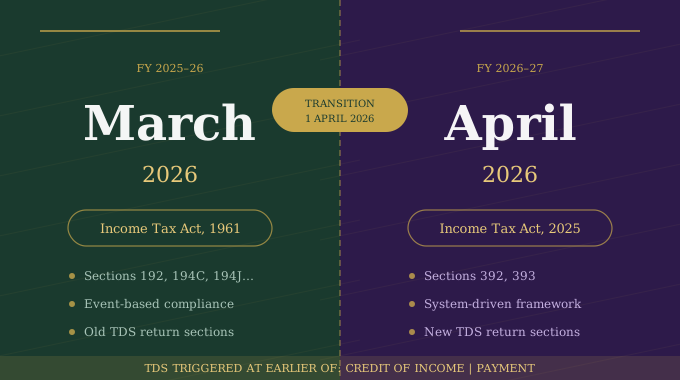
- The Income Tax Act, 2025 is effective from 1 April 2026, applicable from FY 2026–27 onwards.
- FY 2025–26 (including March 2026) continues to be governed by the Income Tax Act, 1961.
- This creates a unique compliance challenge — two different tax laws may apply to a single transaction depending on its timing.
These are transactions where:
⬥ The expense pertains to FY 2025–26 (March 2026), but
⬥ It is recorded or paid in FY 2026–27 (April 2026).
Such timing differences are common near financial year-end closings and require careful determination of which Act governs TDS.
TDS applicability depends on the timing of credit or payment — NOT on the period to which the expense relates. The date of booking/payment is the determining factor for which Act applies.
| Aspect | Income Tax Act, 1961 | Income Tax Act, 2025 |
|---|---|---|
| Structure | Multiple scattered sections (192, 194C, 194J, etc.) | Consolidated provisions (Section 392, 393) |
| Framework | Event-based compliance | System-driven, standardised framework |
| Interpretation | Complex interpretation issues | Simplified and uniform structure |
| Scenario | Applicable Law | TDS Requirement |
|---|---|---|
| Expense of March 2026 booked in March 2026 | IT Act, 1961 | TDS under old provisions |
| Expense of March 2026 booked in April 2026 | IT Act, 2025 | TDS under new provisions |
| Provision in March without payee identification | Both Acts | No TDS in March → TDS in April under new Act |
- Wrong application of old vs new TDS sections
- Mismatch in TDS returns (old section vs new section)
- Disallowance under applicable provisions
- Interest liability due to timing errors
- Close books properly as on 31 March 2026
- Avoid postponing expense booking to April
- Identify provisions requiring TDS
- Update accounting and TDS software for new law
- Maintain clear documentation for audit trail
This transition year (FY 2026–27) requires special attention because:
- The same transaction may relate to two different laws depending on when it is recorded.
- ERP and accounting systems must be updated to reflect the new section mapping under the 2025 Act.
- Section references change completely — old TDS sections (192, 194C, 194J, etc.) give way to the new consolidated provisions (Sections 392, 393).
Everything you need to know about the restructured TDS & TCS sections — mapped, explained, and ready to apply.
👉 taxroutine.com/income-tax-act-2025/new-tds-and-tcs-payment-sections/Don’t quote the wrong code. Get the full updated list of TDS & TCS payment codes under the new Act.
👉 taxroutine.com/income-tax-act-2025/new-tds-and-tcs-payment-codes/Conclusion
The transition from the Income Tax Act, 1961 to the Income Tax Act, 2025 fundamentally restructures the TDS framework — but the core trigger principle remains unchanged: TDS is governed by the timing of credit or payment.
For cross-period transactions between March and April 2026, the date of booking/payment determines whether the old law or the new law applies — making this one of the most critical areas for compliance in the transition year.