
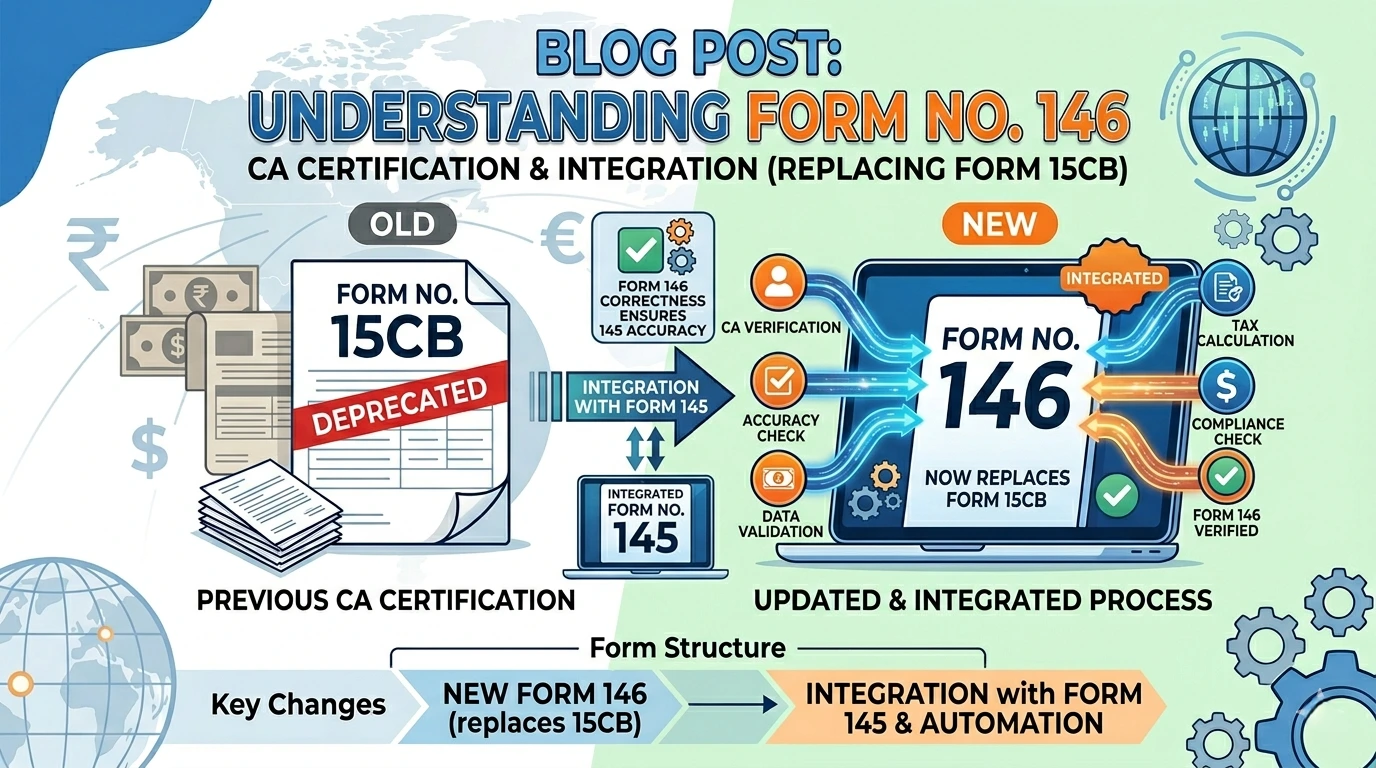
Form No. 146 (Erstwhile Form 15CB): The CA’s Certificate for Foreign Remittances — What You Need to Know
📋 Quick Reference
1What is Form No. 146?
Form No. 146 is an Accountant’s certificate — filed by a Chartered Accountant — that certifies the tax position on a proposed foreign remittance. It is required when:
- The payment is to a non-resident (not being a company) or a foreign company
- The remittance is chargeable to tax in India
- The aggregate remittances in the tax year exceed ₹5 lakh
- A certificate from the Assessing Officer under Section 395(1)/(2) has not been obtained
The CA examines the remittance against chargeability provisions under Sections 5 and 9 of the Income-tax Act, 2025 and any applicable DTAA provisions, and certifies the TDS rate and taxability.
2Who Files It — and When?
Form No. 146 is filed by the Chartered Accountant, not the remitter. However, the process involves both parties:
🔄 The Two-Party Workflow
3Prerequisites for the CA
- Must be registered as a Chartered Accountant on the Income Tax e-Filing portal (under the Tax Professional category)
- Must have a registered Digital Signature Certificate (DSC) on the portal — DSC is the only permitted e-verification method for Form No. 146
- Must have been assigned Form No. 146 by the remitter/taxpayer via the “Add CA” feature on the portal
4How to File Form No. 146 (Online)
5What is UDIN and Why Does it Matter?
UDIN (Unique Document Identification Number) is an 18-digit system-generated alphanumeric number issued by the ICAI portal after the CA files the form. It is now mandatory for Form No. 146 per ICAI notification.
UDIN enables real-time authenticity verification of the CA’s certificate via an API link between the Income Tax Department and ICAI — preventing fraudulent or forged certificates from being used to process foreign remittances.
6Modification, Withdrawal & “Consumed” Status
| Action | Permitted? | Key Condition |
|---|---|---|
| Modification / Editing | ❌ Not allowed | Once submitted, cannot be changed |
| Withdrawal by CA | ✅ Within 7 days | Only if Form No. 145 Part C has not been filed against it |
| Withdrawal after consumption | ❌ Not independently | CA cannot withdraw if Form No. 145 Part C has been filed; remitter must first withdraw Form No. 145 |
| Auto-withdrawal | ✅ Automatic | If the remitter withdraws Form No. 145 Part C, the linked Form No. 146 automatically updates to “Withdrawn” |
| “Consumed” status | — | After Part C of Form No. 145 is successfully filed using the Form No. 146 acknowledgement number, status changes to “Consumed.” One Form No. 146 = one Form No. 145 only. |
7Penalty for Inaccurate Certification
Up to ₹10,000 Per Certificate
Under Section 463 of the Income-tax Act, 2025, if an accountant provides inaccurate information in Form No. 146, a penalty of up to ₹10,000 is leviable for each such certificate.
8Key Changes from Form 15CB to Form No. 146
No TIN field for remittee without PAN
No structured capital gains table
Certificate number row present
No PAN of accountant field
No Firm Registration Number (FRN)
No UDIN requirement
Authenticity of CA certificate could not be independently verified
✅ TIN field added for non-PAN remittees
✅ Structured capital gains table (date of sale, acquisition, full consideration)
✅ Certificate number row removed
✅ PAN of accountant added
✅ Firm Registration Number (FRN) added
✅ UDIN mandatory; real-time ICAI API verification
✅ CA identity verifiable against Department’s database via PAN + FRN
Form No. 145 & 146 — Download Both Forms
Form 146 is filed by the CA. The remitter files Form 145 Part C using the Form 146 acknowledgement number.
Enjoyed studying this, very good stuff, appreciate it.