
The Bribe Behind
The Badge
GST officers across India — CGST and SGST alike — continue to demand bribes from taxpayers even as the government promises a faceless, corruption-free administration. The gap between the policy promise and the ground reality has never been wider.
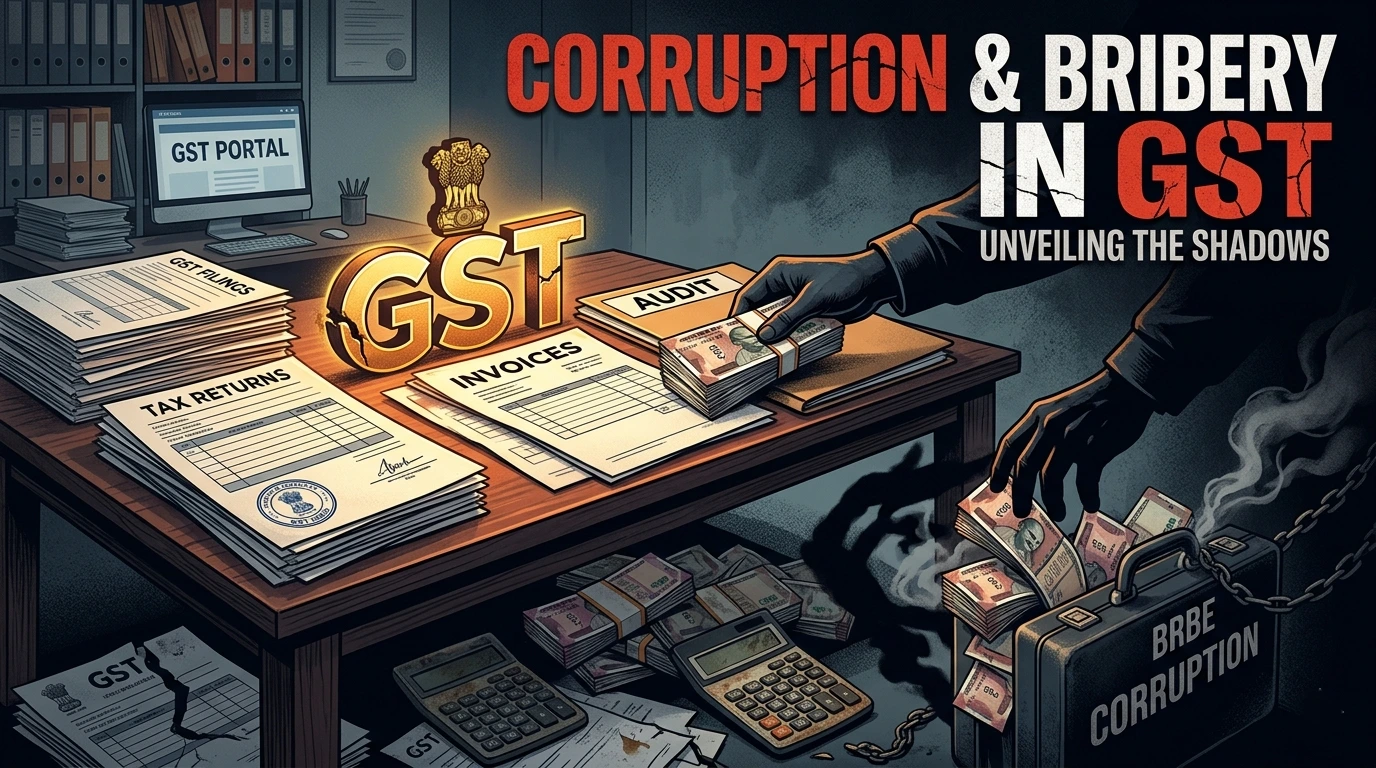
Every year, the Finance Ministry speaks of technology-driven, faceless assessments designed to eliminate the interface between taxpayer and officer. Every year, thousands of businesses — small traders, startups, manufacturers, exporters — quietly pay thousands of rupees to GST officers just to be left alone. Not because they have done anything wrong. But because in the world of field-level GST enforcement, peace costs money.
This is not a fringe issue confined to a rogue officer in one district. It is a systemic, pan-India problem spanning both Central GST (CGST) and State GST (SGST) departments. The officers change, the states change, the amounts change — but the arithmetic of extortion remains depressingly constant.
TaxRoutine has documented publicly reported cases from Tamil Nadu to Uttar Pradesh to Chhattisgarh. We have also received first-hand accounts from tax practitioners in Chennai that paint a picture of corruption that has evolved — and in some ways worsened — in the GST era.
reported here
single Ghaziabad case
on GST refunds (Chennai)
one UP CGST superintendent
The Cases on Record
These are cases that were caught. Documented. Prosecuted or investigated. For each one that surfaces, practitioners who work the ground will tell you there are dozens that never do — where the businessman paid up, kept quiet, and moved on.
A Superintendent of GST, Ranipet Range, demanded ₹30,000 from a complainant to facilitate the clearance of GST registration — one of the most basic, rights-based services the department is obligated to provide. After negotiation, the bribe was fixed at ₹15,000.
The CBI laid a trap on 07 April 2026. As the trap proceeded, the role of the Inspector, GST Ranipet Range, also surfaced. In a detail that says more about the moral calibre of these officers than any verdict can: the Inspector concealed the trap money in a toilet commode and attempted to flush it upon seeing the CBI team. The amount was subsequently recovered from the toilet. Both were arrested.
A business owner had to approach the CBI — India’s premier anti-corruption agency — simply to get a GST registration processed. That is the state of first-mile tax administration in India today.
Arun Kumar Som, director of SKS Electricals, Ghaziabad, had his office raided by a DGGI team on 5 July 2022. A company director was arrested without a warrant. What followed was a textbook extortion campaign: ₹5 crore demanded to “settle” the matter, with the explicit assurance that the money “will be distributed among the top officials.”
Fearing arrest and “social disgrace,” Som paid ₹50 lakh at Bengali Market, Delhi. Then ₹1 crore outside the DGGI Gurugram office. Then ₹75 lakh at NSC Club, Pragati Maidan. In January 2023, a new officer called — introducing himself as the replacement investigating officer — and demanded an additional ₹50 lakh. Som paid ₹10 lakh more, bringing his total to approximately ₹2.35 crore.
When he filed a police complaint, no FIR was registered. He filed another at the Police Commissionerate. Still no action. He was forced to approach a court under CrPC 156(3) before an FIR was finally registered under Section 7 of the Prevention of Corruption Act, 1988. The police had to be ordered by a court to do their job.
CGST Superintendent Nishan Singh Malli and tax advocate Amit Khandelwal were caught accepting ₹1 lakh — the first instalment of a ₹4 lakh bribe — to “settle” a penalty notice issued to a businessman for not filing GST returns during the COVID-19 lockdown. The penalty notice itself was arguably punitive given the circumstances. The bribe demand made it extortionate.
CBI raids after the arrest uncovered the true scale of what one officer had accumulated: 17 properties across Ghaziabad, Moradabad, Rampur, and Gajraula — flats, commercial shops, and residential plots. Plus ₹3 lakh unaccounted cash, a Hyundai Creta SUV, confidential department files, and hard drives. The CBI noted that the scale of personal wealth was “disproportionate to known income sources.” That is an understatement that would embarrass a diplomat.
Superintendent Pallav Parganiya and Ashish Pathak were suspended after traders in Chhattisgarh complained of being coercively collected from under the guise of GST irregularities. The Finance Minister had to personally escalate the matter to GST headquarters in Delhi before any internal action was taken.
Critically, similar complaints had reportedly been raised earlier — and not pursued. It took political intervention to trigger a suspension. How many complaints were quietly buried before this one reached a minister’s desk?
What TaxRoutine Has Learnt From the Ground — Chennai
The following information has been gathered from tax practitioners operating in Chennai-based GST circles. Individual identities are not disclosed. These are shared in public interest to highlight ground realities that affect thousands of small businesses.
Officers have increasingly shifted bribe demands to WhatsApp voice calls, operating under the belief that such calls are untraceable or harder to record as evidence. This represents a deliberate attempt to use technology to evade accountability — not to improve it.
CGST officers are understood to demand a standard bribe of 2% to 5% of refund amounts sought by taxpayers. A business legitimately claiming ₹10 lakh in refunds may be asked to part with ₹20,000–₹50,000 to have it processed without obstruction. Refunds are a right — not a favour.
SGST officers are reportedly demanding bribes to close scrutiny notices under Sections 73 and 74 — even where the issues are purely technical in nature with no genuine tax liability. Some officers have reportedly described this as an “annual ritual,” with the expectation that taxpayers will ensure “everyone is happy” every year. Extortion, normalised and scheduled.
Field officers visiting business premises for physical verification during the GST registration process demand cash payments. This is the first touchpoint between a new business and the tax system — and it begins with corruption.
Bribes have reverted to cash-only mode, likely to avoid digital trails. In one particularly shocking case reported to TaxRoutine, an officer asked the bribe amount to be transferred to a specific phone number — which turned out to be the bank account of a GST consultant. The money was being routed through an intermediary, an ecosystem of complicity that extends beyond the officer alone.
In perhaps the most brazen practice reported, some officers explicitly frame Section 73 scrutiny notices as a recurring income mechanism. Taxpayers are told — in so many words — that paying a few thousand rupees annually keeps the notices away and “everyone happy.” Many small businesses have accepted this as the cost of doing business in India. That acceptance is itself a measure of institutional failure.
Both Sides of the Counter
It would be dishonest to present taxpayers purely as victims in every case. Demanding a bribe is a crime. But paying one is also wrong — and in most cases, illegal under the Prevention of Corruption Act. TaxRoutine does not recommend or endorse paying bribes under any circumstances.
But the reality must also be acknowledged honestly: most taxpayers who pay bribes are not on the wrong side of the law. They are not trying to hide genuine liability. They are buying peace — paying ₹5,000 to avoid months of harassment, frivolous notices, and the grinding uncertainty of an officer who can make their compliance life miserable with impunity.
When a small trader in Chennai says “paying five thousand to a GST officer buys me a year of peace from Section 73 notices,” that is not a confession of wrongdoing. That is a devastating indictment of a system that has failed to protect them.
What This Costs the Country
Corruption in tax administration is not merely a governance failure. It is an economic one. Every bribe paid by a small business is capital that does not get reinvested. Every registration delayed by an officer seeking a payment is a business that starts late, spends more, and grows less. Every refund held hostage is working capital that a manufacturer or exporter cannot deploy.
The cumulative effect — across millions of interactions between field officers and small businesses every year — represents a massive and invisible tax on enterprise that falls disproportionately on those least able to absorb it.
- It makes India structurally less competitive for small businesses relative to countries with cleaner tax administration
- It rewards informal operation — businesses that stay below the GST registration threshold avoid this system entirely, which distorts market competition
- It discourages new registration, undermining the government’s own formalization agenda
- It corrodes trust in institutions — when every interaction with the state begins with a bribe demand, citizens lose faith in the system itself
If You Are Asked for a Bribe — Report It
Silence protects the corrupt. Reporting — even anonymously — creates a record, triggers investigations, and in documented cases, leads to arrests. You do not have to accept this as normal.
Use the right channel based on whether the officer is from the Central GST (CGST) department or your State GST (SGST) department — they are governed by different jurisdictions.

Nungambakkam, Chennai – 600006
📞 044-28273186
Handles complaints against CGST / Central Government officers. The Ranipet case (Case 01 above) was registered and trapped by this very office.
📞 011-24651020
Aadhaar-based authentication required.
Covers CGST officers across India regardless of state.
Secretary, Central Vigilance Commission, Satarkta Bhawan, GPO Complex, INA, New Delhi – 110023
The envelope must be clearly marked: “Complaint under the Public Interest Disclosure” or “PIDPI”
Important rules for the complainant:
- Your name and address must appear inside the complaint or in an attached letter — not on the outer envelope
- The outer envelope should carry no identifying information about you
- Applies only to Central Government employees — CGST, DGGI and other central officers qualify; SGST officers do not fall under PIDPI jurisdiction
📞 044-28592750
📱 Toll-Free: 1800-425-0150
Complaints can be submitted in person, by post, or online through the DVAC portal.
Complaints can be filed in writing or through the Tamil Nadu Government grievance portal.
Before you file: Preserve all communications — WhatsApp messages, call logs, emails, SMS. Note dates, times, officer names, designation, and exact demands made. A documented complaint is exponentially stronger than an oral one.
The Promise vs. The Reality
Faceless assessments are a genuine step forward in reducing discretionary power. The GST portal, e-invoicing, and automated return processing have all reduced friction in some areas. Credit where it is due.
But technology-driven reform at the top of the stack means very little when the officer at the bottom of it — the Superintendent visiting your office for a registration inspection, the SGST officer holding your Section 73 notice — still operates in a world where accountability is absent and impunity is the default.
The government’s promise of a corruption-free tax administration will remain just that — a promise — until the consequences for officers who demand bribes are swift, severe, and certain. Until then, the badge will continue to be a licence to collect.