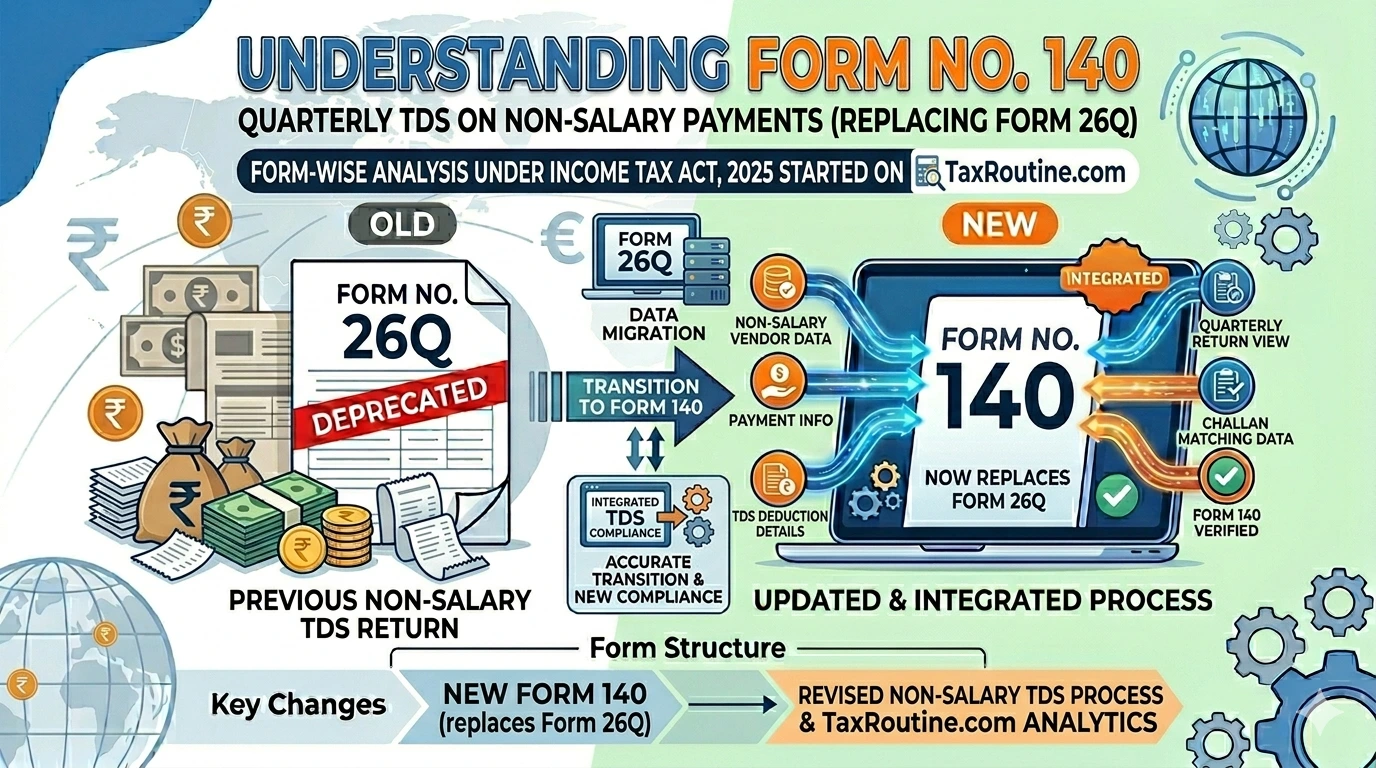
Quick summary: Form 26Q — the quarterly TDS statement filed by deductors on all non-salary payments to residents — is now Form No. 140 under the Income-tax Act, 2025 and I.T. Rules, 2026. It is the non-salary counterpart to Form No. 138 (erstwhile Form 24Q) and is the source document from which TRACES generates Form No. 131 (erstwhile Form 16A). Around 50–55 lakh original filings are made each year, making this one of the most widely filed TDS statements in India.
📋 Quick Reference
Old Form NameForm 26Q
New Form NameForm No. 140
Old RuleRule 31A, I.T. Rules 1962
New RuleRule 219, I.T. Rules 2026
Old Act SectionSection 200(3), I.T. Act 1961
New Act SectionSection 397(3)(b), I.T. Act 2025
Filed byAny deductor on non-salary payments to residents
FrequencyQuarterly (Q1 to Q4)
GeneratesForm No. 131 (TDS Certificate)
Annual Filings~50–55 lakh original statements
1What is Form No. 140 — and Who Must File It?
Form No. 140 is a quarterly TDS statement filed by deductors to report tax deducted at source on all payments to Indian residents other than salary. It covers a wide range of non-salary income types including:
💰Interest income
🤝Commission & brokerage
📋Professional fees
🏠Rent (specified persons)
📄Contract payments
📊Dividends
🏆Lottery & gaming winnings
🏦Cash withdrawals (banks)
⚡Other specified payments
Every person — company, firm, partnership, government, or individual — responsible for making any of these payments to a resident on which TDS is deductible must file Form No. 140 for the relevant quarter.
Form No. 140 is one of the most widely filed TDS statements in India with approximately 50–55 lakh original filings per year — more than double the volume of Form No. 138 (salary TDS).
2Form No. 140 vs Form No. 138 — Know the Difference
Both Form No. 138 and Form No. 140 are quarterly TDS statements filed under Rule 219 of the I.T. Rules, 2026 — but they cover entirely different income types and are processed differently.
Form No. 138 (Erstwhile 24Q)
Covers salary payments under Section 392
Also covers specified senior citizen pension/interest via specified banks
Has three annexures — Annexure II and III filed only in Q4
Generates Form No. 130 (annual TDS certificate)
~22.5 lakh filings/year
Form No. 140 (Erstwhile 26Q)
Covers all non-salary payments to residents under Sections 393(1) and 393(3)
Filed by any deductor — company, bank, individual, government
Has a single annexure filed across all four quarters
Generates Form No. 131 (quarterly TDS certificate)
~50–55 lakh filings/year
3Due Dates for Filing
Quarter
Period Covered
Due Date
Q1
April – June
31st July of the Financial Year
Q2
July – September
31st October of the Financial Year
Q3
October – December
31st January of the Financial Year
Q4
January – March
31st May of the FY immediately following the Tax Year
Missing Q4 is the most common error — its due date falls in the next financial year (31st May). A delayed Form No. 140 directly delays the deductee’s Form No. 131 and blocks their TDS credit from reflecting in Form No. 168.
4Structure of Form No. 140
Form No. 140 has a straightforward two-part structure with a single annexure filed across all four quarters.
Part A
Deductor Details
Type of deductor, name, address, PAN, TAN, email, contact number, tax year, and details of the person responsible for TDS deduction. Government deductors also provide AIN of PAO/DTO/CDDO.
Required: All 4 quarters
Part B
Challan / Payment Details
Total tax deducted, interest, late filing fee, mode of payment (challan or book adjustment), BSR code, date of deposit, challan serial number, and minor head of challan.
Required: All 4 quarters
Annexure
Deductee-wise TDS Breakup
PAN and name of deductee, section code, date of payment/credit, amount paid/credited, total TDS deducted, tax deposited, rate of deduction, date of deduction, reason for non/lower/higher deduction, certificate number under Section 395, and — uniquely — the Unique Identification Number (UIN) of Form No. 121 submitted by the deductee for nil/lower deduction claims.
Required: All 4 quarters
🆕 New Field in Form No. 140 Annexure
Form No. 140’s Annexure includes a field for the Unique Identification Number (UIN) of Form No. 121 — the nil/lower TDS declaration form submitted by deductees who claim exemption from TDS. This field did not exist in Form 26Q and enables direct cross-verification between the deductee’s exemption claim and the deductor’s statement at the CPC-TDS level.
5How to File Form No. 140
1
Deduct TDS and pay to Central GovernmentDeduct TDS at the time of payment or credit of the non-salary income to the resident. Deposit to Central Government within due dates under Rule 218 of I.T. Rules, 2026.
2
Prepare the statement using RPUUse the Return Preparation Utility (RPU) provided by TIN-NSDL to prepare the quarterly statement. Prepare Part A, Part B, and the Annexure with deductee-wise TDS details.
3
Validate using File Validation Utility (FVU)Run the file through the FVU. A successful validation generates a .fvu file for upload.
4
Upload and receive ARNUpload the .fvu file at the e-filing portal (incometax.gov.in) or at a TIN FC centre. On successful submission, an Acknowledgment Receipt Number (ARN) is issued.
5
Processing at CPC-TDSThe statement is processed at CPC-TDS. Defaults (short deduction, interest, late fee) are notified on TRACES. File correction statements within two years from the end of the Tax Year to clear any defaults.
6What Happens After Form No. 140 is Processed?
Form No. 131 is generated (Erstwhile Form 16A)TRACES generates quarterly TDS certificates in Form No. 131 based on the deductee-wise data in the Annexure. The deductor downloads and issues these to each deductee within 15 days of the Form No. 140 due date.
TDS reflects in deductee’s Form No. 168 (Erstwhile Form 26AS)The deducted TDS amount appears as “TDS by deductor” in the deductee’s Annual Information Statement, enabling them to claim credit when filing their ITR.
Default processing for the deductorStatements processed with defaults trigger demand notices on TRACES. Deductors must pay the default amount and file correction statements to close the demand.
7Key Changes from Form 26Q to Form No. 140
Form 26Q (Old)
Token Number for identification
TAN Registration Number field present
Surcharge and cess as separate fields in challan details
No UIN field for Form 15G/15H (nil deduction declarations)
Terminology: “Assessment Year / Financial Year”
Currency: Rs.
Static form — fully manual entry
Form No. 140 (New)
✅ Token No. replaced with Return Receipt Number
✅ TAN Registration Number deleted
✅ Surcharge and cess consolidated under challan total
✅ New UIN of Form No. 121 field in Annexure for nil/lower deduction cross-verification
✅ Unified “Tax Year” terminology
✅ Currency updated to ₹
✅ Smart form: auto-population, real-time validations, API integrations
8Penalties for Non-Compliance
🚨
Late Filing Fee — Section 427
A fee under Section 427 is levied for late filing of Form No. 140. This must be deposited before filing the delayed statement and is reported in the “Total Fee” column (Column D) of Part B.
⚖️
Penal Proceedings — Sections 461 and 465(2)(g)
Persistent non-filing or inaccurate filing can attract penal proceedings under Sections 461 and 465(2)(g). Timely, accurate filing protects both the deductor from penalties and the deductee from losing TDS credit.
9Frequently Asked Questions
Form No. 140 is a quarterly statement filed by deductors (companies, firms, banks, etc.) covering a broad range of non-salary TDS payments to residents. Form No. 141 is a challan-cum-statement filed by individuals and HUFs for specific transaction-based TDS deductions — rent, property purchases, professional/contract payments, and VDA transfers — where the deductor is typically not required to hold a TAN. Form No. 141 is filed per transaction, not quarterly.
No. Form No. 140 cannot be edited once submitted. To correct an error, the deductor must file a correction statement after the original has been processed by CPC-TDS. The correction window is two years from the end of the Tax Year in which the statement was due — for example, corrections to Q2 of Tax Year 2026-27 can be filed up to 31st March 2029.
A deductor must file Form No. 140 for any quarter in which they were required to deduct TDS on non-salary payments to residents. If no such payments were made in a quarter, no filing obligation arises for that quarter. However, if a deductor has a TAN and made payments below the threshold in a quarter, it is advisable to check the relevant section’s threshold rules before concluding no filing is needed.
Form No. 121 is the new declaration form (replacing Form 15G/15H) submitted by deductees who claim nil or lower TDS deduction. When a deductee submits Form No. 121 to the deductor, the deductor must report the Unique Identification Number (UIN) of that declaration in the Annexure of Form No. 140. This allows CPC-TDS to cross-verify the nil deduction claim directly against the deductee’s declaration.
If a deductee’s TDS is not showing in their Form No. 168 (erstwhile Form 26AS), check: (1) whether Form No. 140 was filed for the relevant quarter; (2) whether it was processed by CPC-TDS without defaults — unprocessed or defaulted statements do not reflect TDS credits; (3) whether the deductee’s PAN was quoted correctly in the Annexure — an incorrect PAN means credit goes to the wrong account. Rectify by filing a correction statement with the correct PAN.
Download Form No. 140
Access the official CBDT-notified form in PDF format.
CA Final Student & Semi-Qualified Chartered Accountant
Ruban Jayakumar is a CA Final student and semi-qualified Chartered Accountant specializing in taxation, accounting, and finance. With over five years of experience in tax litigation before appellate forums, he works closely with businesses and individuals to simplify complex tax and compliance matters. Through TaxRoutine, he shares practical insights aimed at making taxation accessible and understandable for the general public.