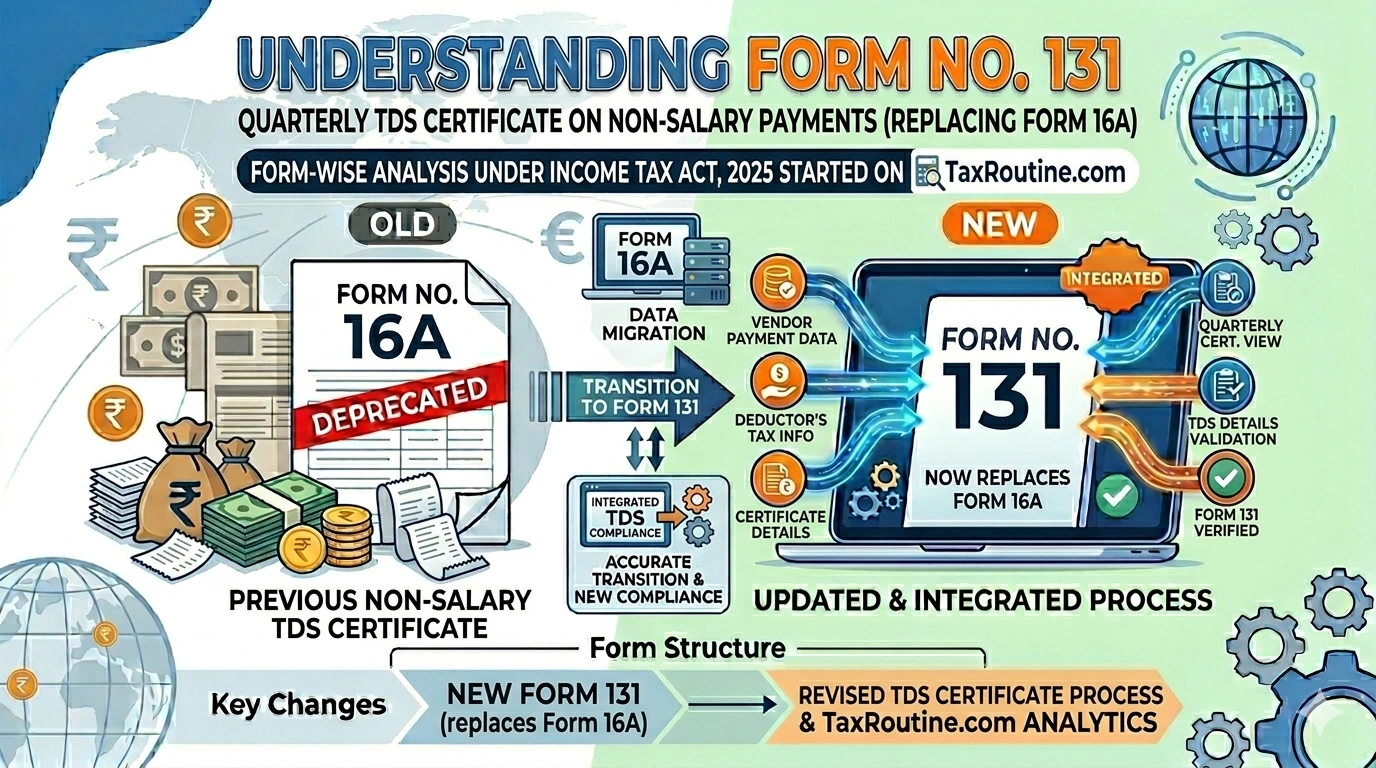
Quick summary: Form 16A — the quarterly TDS certificate issued to deductees on non-salary income — is now Form No. 131 under the Income-tax Act, 2025 and I.T. Rules, 2026. If you earn rent, interest, professional fees, commission, or any other non-salary income from which TDS is deducted, this is the certificate your deductor is obligated to issue you every quarter. It is generated from TRACES based on Form No. 140 or Form No. 144 filed by the deductor.
📋 Quick Reference
Old Form NameForm 16A
New Form NameForm No. 131
Old RuleRule 31, I.T. Rules 1962
New RuleRule 215(1) [Table: Sl. No. 2], I.T. Rules 2026
Old Act SectionSection 203, I.T. Act 1961
New Act SectionSection 395(4)(a), I.T. Act 2025
Issued byAny deductor on non-salary payments
FrequencyQuarterly (Q1 to Q4)
Generated fromForm No. 140 or Form No. 144
SourceTRACES portal only
Applicable to NRIs?Yes, with valid PAN
Duplicate allowed?Yes, from TRACES
1What is Form No. 131?
Form No. 131 is a quarterly TDS certificate issued by a deductor to a deductee for tax deducted at source on payments other than salary. It serves as the deductee’s proof that TDS has been deducted from their income and deposited with the Central Government — enabling them to claim that credit when filing their income tax return.
The types of income for which Form No. 131 is commonly issued include:
Form No. 131 is issued quarter by quarter, unlike Form No. 130 (erstwhile Form 16) which is issued annually. If TDS has been deducted on your non-salary income across all four quarters, you should receive four separate Form No. 131 certificates — one per quarter from each deductor.
2Form No. 131 vs Form No. 130 — Know the Difference
Both Form No. 130 and Form No. 131 are TDS certificates, but they serve entirely different deductees and income types. Confusing the two is one of the most common errors in TDS compliance.
Form No. 130 (Erstwhile Form 16)
Issued on salary income under Section 392
Issued annually — once per Tax Year
Issued by employer to employee
Generated from Form No. 138 (erstwhile 24Q)
Due by 15th June of the following FY
Contains full tax computation (Part C)
Form No. 131 (Erstwhile Form 16A)
Issued on non-salary income of all kinds
Issued quarterly — four times per Tax Year
Issued by any deductor (company, bank, individual, etc.)
Generated from Form No. 140 or 144
Due within 15 days of the TDS statement due date
Contains payment summary + TDS details only (Parts A and B)
3Structure of Form No. 131
Form No. 131 has a lean, two-part structure — it does not contain a tax computation section like Form No. 130. Its purpose is specifically to certify the amount paid and the TDS deducted and deposited.
Part A
Deductor & Deductee Details
Name, address, PAN, TAN, email, contact details of both the deductor and deductee. Also includes the tax year and quarter for which the certificate is issued.
Part B
Payment & TDS Summary
Nature of payment, amount paid/credited, date of payment, total TDS amount, rate of deduction, and amount deposited. Includes challan details (BSR code, date, serial number, status of matching with TIN 2.0) or Book Identification Number (BIN) details for government deductors.
Declaration
Signed Certification by the Deductor
Signed declaration by the person responsible for TDS deduction — certifying name, PAN, designation, and the exact amount deducted and deposited to the credit of the Central Government. Must be signed digitally or physically by the deductor.
4Due Dates for Issuance
Form No. 131 is issued quarterly — within 15 days from the due date of furnishing the corresponding quarterly TDS statement. The schedule is:
Quarter
Period
TDS Statement Due
Form No. 131 Due
Q1
Apr – Jun
31st July (FY)
15th August (FY)
Q2
Jul – Sep
31st October (FY)
15th November (FY)
Q3
Oct – Dec
31st January (FY)
15th February (FY)
Q4
Jan – Mar
31st May (following FY)
15th June (following FY)
The due date for Form No. 131 is tied to the TDS statement due date — not to when the TDS was actually deposited. If Form No. 140 or 144 is filed late, the Form No. 131 clock still runs from the original due date of the TDS statement.
5How Form No. 131 is Generated and Issued
1
Deductor files the quarterly TDS statementThe deductor files Form No. 140 (for non-salary domestic payments, erstwhile Form 26Q) or Form No. 144 (for payments to non-residents, erstwhile Form 27Q) on the TRACES / e-filing portal.
2
Statement is processed at CPC-TDSOnce the filed statement is processed without defaults, the deductee-wise data becomes available for certificate generation on TRACES.
3
Deductor places download request on TRACESThe deductor logs into TRACES and requests Form No. 131 download for each deductee. Only certificates generated from TRACES are legally valid — certificates prepared through any other mode are not valid.
4
Sign and issue to deducteeThe downloaded certificate must be signed — either digitally (DSC) or physically (manual signature) — and issued to the deductee within the due date. The deductee uses it to claim TDS credit in their ITR.
6Multiple Deductors — Each Issues Separately
Each deductor issues a separate Form No. 131. If your non-salary income comes from multiple sources — for instance, rent from one company, interest from a bank, and professional fees from another firm — each of those deductors is independently required to issue you a Form No. 131 for their respective deductions. There is no consolidated certificate.
For example, a freelance consultant who receives professional fees from three different clients will receive three separate Form No. 131 certificates per quarter — one from each client that deducted TDS. All three must be accounted for when filing the ITR to claim the full TDS credit.
7Applicability to Non-Residents
Form No. 131 is also applicable to payments made to non-residents — wherever TDS is deducted on such payments and the transaction is reported in Form No. 144 (erstwhile Form 27Q) with a valid PAN of the deductee. This makes Form No. 131 a critical document in cross-border income scenarios such as royalties, interest, dividends, and technical service fees paid to NRIs or foreign companies.
If you are an NRI receiving income from India on which TDS has been deducted, ensure your Indian PAN is registered with the deductor. Without a valid PAN linked to Form No. 144, the certificate cannot be generated on TRACES.
8Key Changes from Form 16A to Form No. 131
Form 16A (Old)
References to Assessment Year, Financial Year, Previous Year
Section references under I.T. Act, 1961
Currency symbol: Rs.
Name, address, PAN grouped together in same fields
No pre-filling from portal data
Form No. 131 (New)
✅ Unified “Tax Year” terminology throughout
✅ All references updated to I.T. Act 2025 section numbering
✅ Currency symbol updated to ₹
✅ Name, Address, PAN separated into distinct fields for system compatibility
✅ Pre-filled to the extent possible from TRACES portal data
9Errors in Form No. 131 — How to Get It Corrected
Like Form No. 130, Form No. 131 cannot be corrected directly. The correction path runs through the underlying TDS statement:
The deductor must file a revised TDS statement in Form No. 140 or Form No. 144 within the stipulated correction window
Once the revised statement is processed by CPC-TDS, the corrected data is reflected on TRACES
The deductor can then download and issue the corrected Form No. 131 to the deductee
A duplicate Form No. 131 can be downloaded from TRACES at any time if the deductee loses the original. The deductor must mention on the certificate that it is a duplicate.
10Frequently Asked Questions
No. The quarterly TDS statement in Form No. 140 or Form No. 144 must be filed and processed by CPC-TDS before Form No. 131 can be generated and downloaded from TRACES. A certificate prepared outside TRACES has no legal validity.
No. Form No. 131 is not required to be attached with the income tax return. However, it must be preserved for record purposes. The TDS credit shown in Form No. 131 should match what appears in your Form No. 168 (erstwhile Form 26AS) — always reconcile before filing your ITR.
First, check your Form No. 168 (erstwhile Form 26AS) on the Income Tax portal — if the TDS is reflected there, you can claim the credit in your ITR even without the certificate in hand. If the TDS is not reflecting in Form No. 168, it likely means the deductor has not filed Form No. 140 or 144. In that case, follow up with the deductor. You can also raise a grievance on the TRACES portal.
Yes. Form No. 131 is applicable to non-residents wherever TDS is deducted on payments and the transaction is reported in Form No. 144 (erstwhile Form 27Q) with a valid PAN of the non-resident deductee.
Form No. 131 is issued against Form No. 140 or 144 — it covers general non-salary income such as interest, rent, professional fees, and NRI payments. Form No. 132 (erstwhile Forms 16B, 16C, 16D and 16E) is issued against Form No. 141 and covers TDS on specific transactions like property purchases, rent paid by individuals, and lottery/horse-race winnings. They serve different deductors and transaction types.
Download Form No. 131
Access the official CBDT-notified form in both PDF and editable Word formats.
CA Final Student & Semi-Qualified Chartered Accountant
Ruban Jayakumar is a CA Final student and semi-qualified Chartered Accountant specializing in taxation, accounting, and finance. With over five years of experience in tax litigation before appellate forums, he works closely with businesses and individuals to simplify complex tax and compliance matters. Through TaxRoutine, he shares practical insights aimed at making taxation accessible and understandable for the general public.