
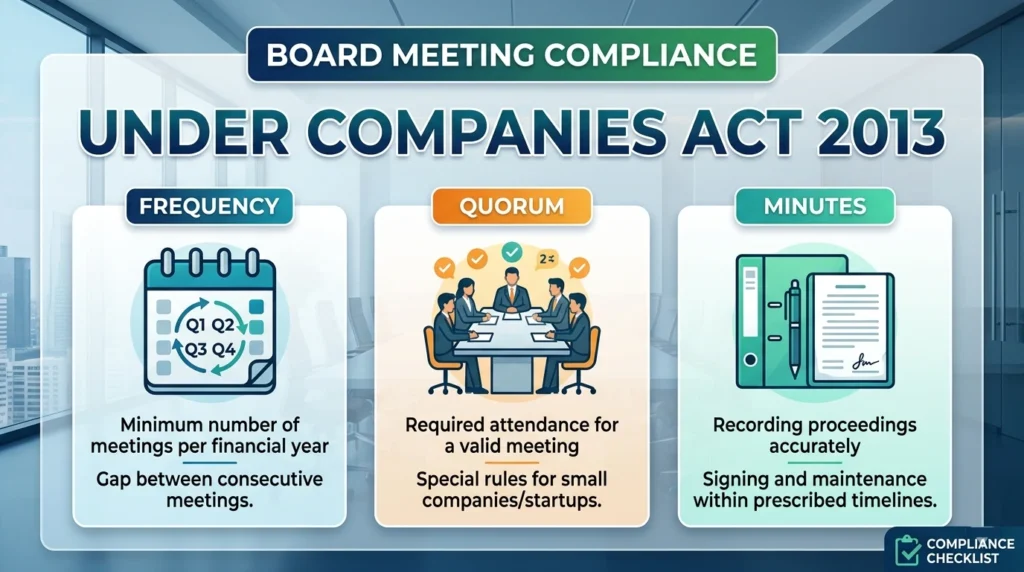
Board Meeting Compliance Under the Companies Act – Frequency, Quorum and Minutes
A complete guide to Sections 173, 174 and 118 of the Companies Act 2013 — covering mandatory meeting frequency, notice requirements, quorum rules, video conferencing restrictions, proper minute-keeping and SS-1 obligations.
In 2023, a Chennai-based private limited company received a penalty notice from the Registrar of Companies — not for tax default, not for GST lapses, but because its second and third board meetings of the year were held just 38 days apart, followed by a 183-day gap before the fourth. The company had technically held four meetings. It had technically not.
The 120-day maximum gap rule under Section 173(1) of the Companies Act 2013 is precise and unforgiving. Miss it by even one day, and the company and every officer in default is exposed to a penalty of ₹25,000 each. The directors in that Chennai firm — two co-founders — paid ₹75,000 for a scheduling oversight.
Board meeting compliance is among the most routinely overlooked obligations of incorporated companies in India. The requirements span three statutes — the Companies Act 2013, the Companies (Meetings of Board and its Powers) Rules 2014, and SS-1 (Secretarial Standard on Board Meetings) issued by ICSI — and together they govern every aspect of how a board must meet: how often, with how many members, with what notice, and what records must be maintained.
This guide walks through each of those requirements in detail, with the penalty implications for each.
1. What is a board meeting under the Companies Act?
A board meeting is a formal meeting of the Board of Directors of a company, convened in accordance with the provisions of the Companies Act 2013 and SS-1. It is the primary governance mechanism through which a company’s directors exercise their collective authority — approving financial statements, authorising borrowings, constituting committees, and discharging the dozens of other functions that the law reserves exclusively for the board.
Board meetings are distinct from general meetings (AGMs and EGMs), which involve the shareholders. The board is accountable to shareholders, and it meets separately to manage day-to-day governance.
Applicability
The board meeting provisions under Sections 173 and 174 apply to:
- —Private limited companies — full applicability, including the four-meetings-per-year minimum.
- —Public limited companies — full applicability.
- —One Person Companies (OPCs) — modified applicability: only one meeting per half-year is required (see Section 173(5)), and quorum requirements do not apply since the sole member is the director.
- —Small companies — as of the Companies (Amendment) Act 2020, small companies may hold at least two board meetings per year, one in each half, in lieu of the general four-meeting requirement.
- —Section 8 companies (non-profits) — full applicability for incorporated Section 8 companies, though many also have parallel obligations under their articles and trust deeds.
“Small company” for FY 2025–26 means a company whose paid-up share capital does not exceed ₹4 crore and turnover does not exceed ₹40 crore, as amended by the Companies (Specification of Definitions Details) Amendment Rules 2022.
2. How many board meetings are required? § 173
Section 173(1) of the Companies Act 2013 mandates that every company (other than a one person company) shall hold a minimum of four board meetings in each calendar year. Crucially, the gap between two consecutive meetings must not exceed 120 days.
This is not a quarterly requirement in the conventional sense — the company is not required to hold one meeting per quarter. What the law requires is that no two consecutive meetings be separated by more than 120 days. A company could technically hold its first three meetings in January, February and March, provided the fourth is held no later than 120 days after the third (i.e., by late June or early July). However, the “at least four per year” minimum still applies.
First board meeting after incorporation
For newly incorporated companies, Section 173(1) requires that the first board meeting be held within 30 days of the date of incorporation. Missing this deadline exposes the company and its directors to the same penalty under Section 173(4). The agenda of the first board meeting typically includes: taking note of the certificate of incorporation, opening of a bank account, appointment of a first auditor (within 30 days as required under Section 139(6)), disclosure of directors’ interests, and adoption of the common seal (if applicable).
The 120-day gap is measured between consecutive meetings — not between a meeting and a fixed calendar quarter. If your Q1 meeting is on 15 January and your Q2 meeting is on 20 May, the gap is 125 days — a violation even though both meetings occurred in the first half of the year.
OPC exception
An OPC (One Person Company) need hold only one board meeting per half-year — i.e., two meetings per year — under Section 173(5). The resolution passed at such a meeting is sufficient without a formal board meeting if the sole director signs the resolution. However, minutes must still be recorded (see Section 118).
3. Notice requirements
Section 173(3) requires that notice of every board meeting be given in writing to every director at his registered address in India, or such other address as may be nominated by him.
- 01Notice period: Not less than 7 days before the meeting. The period is calculated from the date of dispatch of the notice — not receipt.
- 02Shorter notice: A meeting may be called at shorter notice to transact urgent business, subject to the condition that at least one independent director (if any) must be present. If an independent director cannot attend, the decision taken at such a meeting shall be circulated to all directors and ratified by a majority of directors, including at least one independent director, within seven days.
- 03Mode of service: The notice may be served by hand delivery, post, or electronic means. SS-1 requires that notice sent by electronic mode be followed by an email acknowledgement — a requirement often overlooked in practice.
- 04Agenda and explanatory statement: Under SS-1 (which is mandatory, not merely advisory), the notice must be accompanied by an agenda listing all business to be transacted, and an explanatory statement for each item of special business. The agenda must be sent along with the notice — not circulated at the meeting.
- 05Inclusion of additional items: Items not included in the agenda may be taken up for discussion only with the permission of the Chairman and the consent of the majority of directors present at the meeting. Such items cannot be taken up as “any other business” if they involve decisions that require formal approval.
While the bare Act only requires “written notice” of a meeting, SS-1 mandates that the notice also contain the name and address of the venue (if physical), a statement on the availability of video conferencing, and the login details for any VC platform — details the Act itself does not specify. Violation of SS-1 is treated as a violation of Section 118(10) and carries its own penalty.
4. Quorum rules § 174
The quorum for a board meeting is prescribed under Section 174(1) as the higher of:
- —One-third of the total strength of the Board (rounded up to the nearest whole number), or
- —Two directors, whichever is higher.
For example: a board with 5 directors requires a quorum of 2 (one-third of 5 = 1.66, rounded up to 2). A board with 9 directors requires a quorum of 3 (one-third of 9 = 3). A board with 2 directors requires both to be present.
Interested directors and quorum
Section 174(3) introduces an important complication: where the number of interested directors exceeds or equals two-thirds of the total strength, the remaining non-interested directors — provided they are not less than two — shall be the quorum for the transaction of that item of business.
A director who has declared an interest under Section 184(1) in a particular matter must not participate in the discussion or vote on that matter. If this exclusion brings the remaining directors below the quorum threshold, the meeting may still proceed for other agenda items but cannot transact that particular item.
Quorum throughout or only at commencement?
The Act states that quorum must be present at the commencement of a meeting. SS-1 goes further and requires quorum to be maintained throughout the meeting. If quorum falls below the prescribed level at any point during the meeting — due to a director leaving, a connection dropping on VC, or a director recusing himself on an item — the meeting must be adjourned.
Adjourned meeting
Under Section 174(4), where a meeting is adjourned for want of quorum, the meeting stands adjourned to the same day in the next week, at the same time and place. If that day is a national holiday, the adjourned meeting is held on the next succeeding day which is not a holiday. The quorum requirement continues to apply to the adjourned meeting.
Resolutions passed without the requisite quorum are void ab initio — they have no legal effect. Decisions taken without quorum may be challenged by a shareholder under Section 241 (oppression and mismanagement) or by the ROC during inspection. In either case, the company must convene a fresh meeting with proper quorum to validate the decision.
5. Meetings via video conferencing Rule 3
Rule 3 of the Companies (Meetings of Board and its Powers) Rules 2014 permits directors to participate in board meetings through video conferencing or other audio-visual means. A director participating through VC is counted for the purpose of quorum.
The Rules require that the VC system is capable of recording and recognising participation, and that the proceedings are recorded and preserved by the company as part of its records.
Matters that cannot be transacted through video conferencing
Rule 4 of the 2014 Rules specifies certain matters that must be transacted only in a physical meeting — they cannot be approved by a board meeting conducted solely through video conferencing or audio-visual means:
These restrictions mean that many growth-stage companies that operate entirely through Google Meet or Zoom are inadvertently in violation when approving their annual financials. At least some directors must be physically present at the same location for these items.
Matters that can be transacted through VC
A director participating through VC must announce his presence at the beginning of the meeting. He must also confirm, before the start of each agenda item, that he is not attending any other meeting simultaneously. The company secretary or chairperson must take a roll call before transacting business.
6. Minutes of board meetings § 118
Section 118 of the Companies Act 2013 requires every company to maintain minutes of all board meetings. Minutes are the official record of the proceedings and serve as admissible evidence of what transpired at a meeting — both for internal governance and in any legal or regulatory proceedings.
What must minutes contain?
- 01The serial number and type of the meeting, date, venue (or mode if VC), and time of commencement and conclusion.
- 02Names of directors present (physically and via VC), the company secretary, and any invitees.
- 03Record of directors who have been granted leave of absence.
- 04The quorum present at the commencement of business and at the time of each resolution.
- 05For each agenda item: the discussion, dissenting views (if any), and the resolution text in full.
- 06Disclosure of interests by directors under Section 184, and names of directors who abstained from voting.
What may be excluded from minutes?
Under SS-1, the Chairman has the discretion to exclude from the minutes any matter that he considers defamatory, irrelevant, immaterial, or detrimental to the interests of the company. This is not a blanket licence — the Chairman cannot exclude a resolution or a recorded vote simply because it is inconvenient.
Deadlines and signing
| Obligation | Deadline | Authority |
|---|---|---|
| Drafting of minutes after the meeting | Within 15 days (SS-1) | Company Secretary or person authorised |
| Circulation of draft minutes to directors | Within 15 days of meeting | Company Secretary |
| Directors’ comments on draft | Within 7 days of receipt | Each Director |
| Signing / finalisation of minutes | Before the next board meeting, or within 30 days (whichever is earlier) | Chairman of the meeting or next meeting |
| Entry in minute book | Simultaneously with signing | Company Secretary |
Physical vs electronic minute book
Minutes may be maintained in physical bound books or in electronic form. If maintained electronically, they must be in a format that cannot be edited after entry — a plain Word file does not comply. PDF or a dedicated CSMS (Corporate Secretarial Management System) is acceptable. The electronic records must be backed up at regular intervals.
Inspection rights
Under Section 118(10), the minutes of every board meeting are open to inspection by any director of the company. They are not, however, open to general inspection by shareholders (that right is limited to general meeting minutes under Section 119). The ROC and any authorised officer of the Central Government may inspect board meeting minutes under Section 206.
Under Section 118(8), minutes of a meeting are admissible as evidence of the facts stated therein — they create a presumption that the meeting was duly held and convened, and that all appointments made at the meeting were valid. This presumption can be rebutted, but only with affirmative evidence to the contrary.
7. SS-1 — Secretarial Standard on Board Meetings
The Institute of Company Secretaries of India (ICSI) issues Secretarial Standards under Section 118(10) of the Companies Act 2013. Secretarial Standard 1 (SS-1) on Board Meetings is mandatory — non-compliance with SS-1 is treated as a violation of Section 118(10) and carries a statutory penalty.
SS-1 does not merely reiterate the Act. It supplements it with procedural specificity that the Act leaves open. Key areas where SS-1 goes further than the bare Act include:
| Requirement | Bare Act position | SS-1 requirement |
|---|---|---|
| Notice format | Written notice required | Specific contents mandated: venue, VC details, agenda, explanatory statement |
| Agenda circulation | Not specified | Must accompany the notice — not circulated at the meeting |
| Attendance register | Not specified | Must be maintained for every meeting, signed by each director |
| Leave of absence | Not specified | Director must formally apply for leave; Chairman must record grant of leave in minutes |
| Quorum maintenance | At commencement | Throughout the meeting |
| VC roll call | Not specified | Mandatory roll call before start and before each agenda item |
| Minutes circulation | 30 days to sign | Draft within 15 days, comments within 7 days |
| Dissent recording | Not specified | Dissenting views must be recorded at director’s request |
The most commonly observed SS-1 lapses in practice: agenda not attached to the notice, attendance register missing or unsigned, and leave of absence not formally granted or recorded.
8. Penalties for non-compliance
Penalties for board meeting violations are adjudicated under Section 454 of the Companies Act 2013 by the Registrar of Companies (ROC) or officers authorised by the Central Government. Appeals lie before the Regional Director.
| Violation | Section | Penalty — Company | Penalty — Officer in default |
|---|---|---|---|
| Failure to hold requisite number of board meetings | § 173(4) | ₹25,000 | ₹25,000 per director |
| Exceeding 120-day gap between consecutive meetings | § 173(4) | ₹25,000 | ₹25,000 per director |
| Meeting held without requisite quorum — proceedings void | § 174(5) | Decisions void ab initio | — |
| Minutes not maintained or defective | § 118(12) | ₹25,000 | ₹5,000 each (up to 5 officers) |
| Interested director participating in vote | § 184(4) | — | ₹1,00,000 per director |
| Non-compliance with SS-1 | § 118(10) | ₹25,000 | ₹5,000 per officer |
| Matters transacted via VC that require physical presence | Rule 4 | Decisions may be challenged as void | Penalty under § 173(4) |
Penalties under Section 173(4) and 118(12) are civil penalties adjudicated under Section 454. They may be compounded under Section 441 if the amount does not exceed ₹5 lakh — applications for compounding are filed before the Regional Director. Where an offence is compoundable, voluntary disclosure and payment before initiation of adjudication proceedings typically results in lower effective liability.
9. Practical compliance checklist Premium
A zero-defect board meeting requires advance preparation across three stages — before, during, and after the meeting. The 12-point checklist below covers each stage and maps it to the relevant provision.
- Verify meeting schedule: confirm that the gap from last meeting does not exceed 120 days and that the minimum annual count is on track
- Prepare and dispatch board notice not less than 7 days in advance, with agenda and explanatory statement attached
- Confirm email acknowledgements from all directors to whom notice was sent electronically
- Check director interest declarations under Section 184 — identify any items on the agenda that an interested director must recuse from
- Verify VC connectivity and ensure roll call system is in place; confirm that no restricted-category matter is being transacted solely via VC
- Maintain physical or digital attendance register; obtain signatures (or VC acknowledgements) before proceedings begin
- Record leave of absence for absent directors — confirm whether leave was formally applied for
- Check and confirm quorum at commencement — and monitor through each agenda item where director recusal may occur
- Record dissenting views of any director who disagrees with a resolution, at that director’s request
- Draft minutes within 15 days; circulate to all directors; incorporate comments within the next 7 days
- Get minutes signed by the Chairman of that meeting, or by the Chairman of the next meeting
- Enter signed minutes into the minute book; file any resolutions requiring ROC intimation (MGT-14 for specified resolutions) within 30 days
10. Frequently asked questions
Can a board meeting be held on a Sunday or public holiday?
What happens if quorum is not present at the start of a board meeting?
Can a director waive the 7-day notice requirement for a board meeting?
Are resolutions passed at a board meeting binding on all directors, including those who dissented?
Does a company need to file anything with the MCA after each board meeting?
Our compliance retainer covers board meeting scheduling, notice drafting, minutes preparation, and MCA filings — so nothing slips through the gaps.