
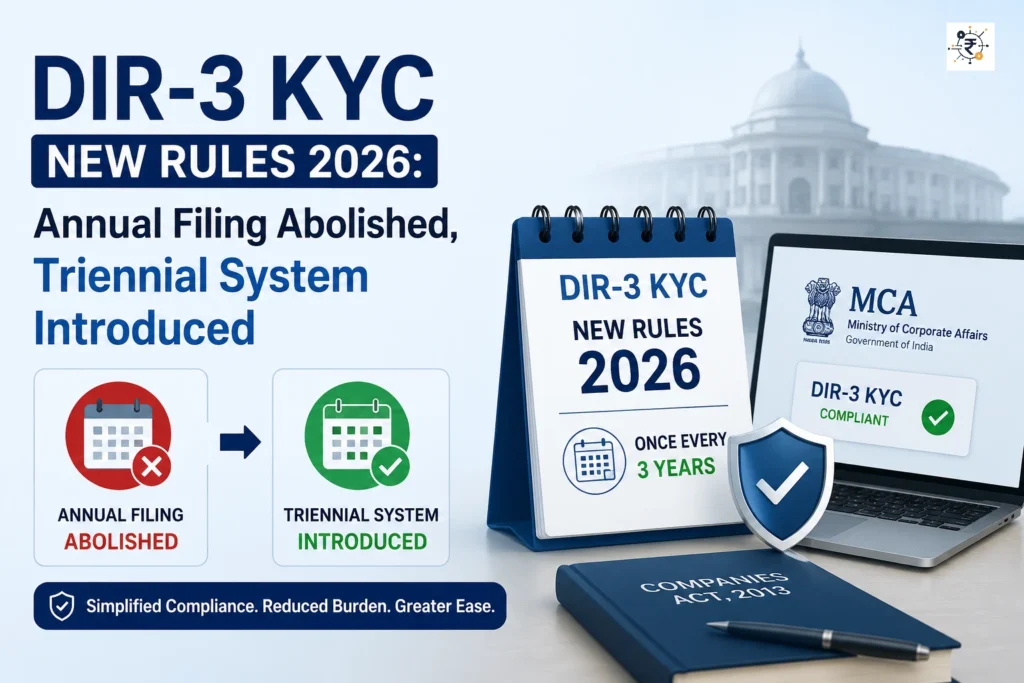
DIR-3 KYC New Rules 2026: Annual Filing Abolished, Triennial System Introduced
📑 In This Article
- Background — What Was the Old Rule?
- What Has Changed Under GSR 943(E)?
- The New Triennial Filing Rule Explained
- Event-Based Updates — When You Must File Immediately
- Due Dates Under the New System
- The Revised DIR-3-KYC-Web Form
- DIN Deactivation — Risk Still Exists
- How to File DIR-3-KYC-Web
- Frequently Asked Questions
1. Background — What Was the Old Rule?
Under the Companies (Appointment and Qualification of Directors) Rules, 2014, every individual holding a Director Identification Number (DIN) was required to file DIR-3 KYC annually — on or before 30th September of every financial year. Failure to file within the due date resulted in deactivation of the DIN, which prevented the director from signing any MCA filings until the KYC was completed along with a late fee.
This annual KYC requirement applied regardless of whether there was any change in the director’s personal details — name, address, mobile number, or email ID. Even if nothing had changed, every director had to go through the process each year.
For directors serving on multiple boards — as is common with Independent Directors in India — this was a significant and repetitive compliance burden with limited practical value beyond the first filing.
2. What Has Changed Under GSR 943(E)?
The MCA, vide G.S.R. 943(E) dated 31st December, 2025, notified the Companies (Appointment and Qualification of Directors) Amendment Rules, 2025. These rules came into force on 31st March, 2026 and make two significant changes:
- DIR-3 KYC required every year
- Due date: 30th September annually
- Both e-form DIR-3-KYC and web service DIR-3-KYC-WEB were options
- Filing required even if no change in details
- Penalty + DIN deactivation on late filing
- DIR-3-KYC-Web required once every 3 years
- Due date: 30th June of the relevant triennial year
- Only web-based Form DIR-3-KYC-Web — no e-form option
- Event-based updates mandatory within 30 days of any change
- DIN deactivation risk remains for non-compliance
Additionally, the notification makes an administrative change in Rule 11 — replacing the designation “Regional Director (Northern Region), Noida” with “Regional Director, Northern Region Directorate I” at all places in the rule.
3. The New Triennial Filing Rule Explained
The substituted Rule 12A reads as follows (as per the official notification):
- Every individual who holds a Director Identification Number as on the 31st March of a financial year shall file KYC intimation in Form No. DIR-3 KYC Web to the Central Government on or before the 30th June of the immediately following every third consecutive financial year.
- Every individual holding a Director Identification Number shall, in the event of change in his personal mobile number, email address or residential address, submit Form No. DIR-3 KYC Web within a period of thirty days of such change along with fee as provided under the Companies (Registration Offices and Fees) Rules, 2014.
In plain language: if you hold a DIN as on 31st March of a financial year, you must file DIR-3-KYC-Web once every three consecutive financial years — by 30th June of the third year. In between, you only file if your personal details change.
4. Event-Based Updates — When You Must File Immediately
Even though routine annual filing is abolished, directors must file DIR-3-KYC-Web within 30 days whenever any of the following changes occur:
| Change in Detail | Filing Required? | Deadline |
|---|---|---|
| Personal mobile number | Yes — mandatory | Within 30 days of change |
| Personal email address | Yes — mandatory | Within 30 days of change |
| Residential address | Yes — mandatory | Within 30 days of change |
| No change in any detail | Not required | Wait for triennial due date |
The 30-day update requirement on change of details carries a fee under the Companies (Registration Offices and Fees) Rules, 2014. Missing this deadline can lead to MCA records becoming inaccurate and may expose the director to compliance risk. Always update promptly when any of the three details change.
5. Due Dates Under the New System
The triennial filing cycle is computed based on when you last completed your DIR-3 KYC. Here’s how the due dates work in practice:
| Last KYC Filed (Financial Year) | Next Triennial KYC Due | Filing Deadline |
|---|---|---|
| FY 2024–25 (i.e., by 30th Sept 2024 or under old rule) | FY 2027–28 | 30th June, 2028 |
| FY 2023–24 | FY 2026–27 | 30th June, 2027 |
| FY 2022–23 or earlier | Check with MCA portal — may already be overdue | Verify immediately |
| New DIN holder (from FY 2025–26 onwards) | Third FY after allotment | 30th June of that year |
If you completed your annual DIR-3 KYC for FY 2024–25 (by 30th September 2024), your next mandatory triennial KYC will only be due on 30th June 2028 — a full 4 years away. This is the maximum benefit under the new system.
6. The Revised DIR-3-KYC-Web Form
The notification also replaces the earlier dual-form system (DIR-3-KYC e-form + DIR-3-KYC-WEB web service) with a single, consolidated Form No. DIR-3-KYC-Web. The physical e-form mode is discontinued — all filings must now be done through the web-based form on the MCA V3 portal.
Purpose Options in the New Form
The revised DIR-3-KYC-Web form supports the following purposes:
- Reactivation of DIN — for directors whose DIN was deactivated due to non-filing
- KYC compliance — routine triennial filing with no changes
- Update of Mobile Number
- Update of Email ID
- Update of permanent residential address
- Update of present residential address
Key Fields in the Form
| Field | Details Required |
|---|---|
| Director Identification Number (DIN) | Mandatory — pre-filled on MCA portal |
| Name | Full name as per DIN records (no abbreviations) |
| Personal Mobile Number | OTP verification required |
| Personal Email ID | OTP verification required |
| Nationality & Date of Birth | As per official records |
| Income Tax PAN | PAN verification mandatory |
| Passport Number | If applicable |
| Permanent & Present Residential Address | With residential proof attachment |
| Digital Signature (DSC) | To be digitally signed by DIN holder |
| Certification by Practicing Professional | CA / CMA / CS in whole-time practice — digital signature required |
The revised form continues to require certification by a Chartered Accountant, Cost Accountant, or Company Secretary in whole-time practice. The professional must verify the particulars from original records and sign the form with their DSC, membership number, and Certificate of Practice number.
7. DIN Deactivation — Risk Still Exists
While the frequency of filing has been reduced, the consequences of non-compliance remain unchanged. A director who fails to file DIR-3-KYC-Web by the due date (whether triennial or event-based) will have their DIN marked as deactivated on the MCA portal.
A deactivated DIN means:
- The director cannot sign or certify any MCA e-form
- All pending company filings that require the director’s DSC get blocked
- The director cannot be appointed to any new company board
- Reactivation requires filing the KYC form with a late fee
DIN deactivation for KYC non-filing is different from director disqualification under Section 164(2) of the Companies Act, 2013 — which triggers when a company fails to file annual returns for 3 consecutive years. Both risks must be managed independently. Read our post on MCA Compliance & Corporate Affairs to track all key deadlines.
8. How to File DIR-3-KYC-Web — Step by Step
-
1
Log in to MCA V3 Portal
Visit mca.gov.in and log in using your registered credentials. Navigate to MCA Services → e-Filing → Company/LLP Master Data → DIR-3-KYC-Web.
-
2
Select the Purpose
Choose the appropriate purpose from the form — routine KYC compliance, update of mobile/email/address, or DIN reactivation. Pre-filled fields will appear based on existing MCA records for your DIN.
-
3
Verify Mobile Number and Email via OTP
The form requires OTP verification for both your registered mobile number and email ID. Ensure your current mobile and email are accessible before starting the form. If these have changed, select the “Update” purpose and submit within 30 days of the change.
-
4
Fill In and Verify PAN Details
Enter your Income Tax PAN and use the “Verify Income Tax PAN” option. Ensure the name on your PAN matches the DIN records to avoid rejection.
-
5
Fill Residential Address Details
Enter your permanent and present residential addresses. Attach the required residential proof — Voter ID, Passport, Driving Licence, Aadhaar, Bank Statement, or Utility Bill (max 2 MB per document).
-
6
Affix DSC and Get Professional Certification
The DIN holder must digitally sign the form. Additionally, a CA / CMA / CS in whole-time practice must certify and sign the form using their DSC, along with their membership number and Certificate of Practice number. False certification attracts liability under Section 448 of the Companies Act, 2013.
-
7
Submit and Pay (if applicable)
Submit the form on the MCA portal. Routine triennial filings within the due date attract no additional fee. Event-based updates and late filings attract fees as per the Companies (Registration Offices and Fees) Rules, 2014. Note the SRN (Service Request Number) generated after submission.
very interesting details you have remarked, regards for posting.