
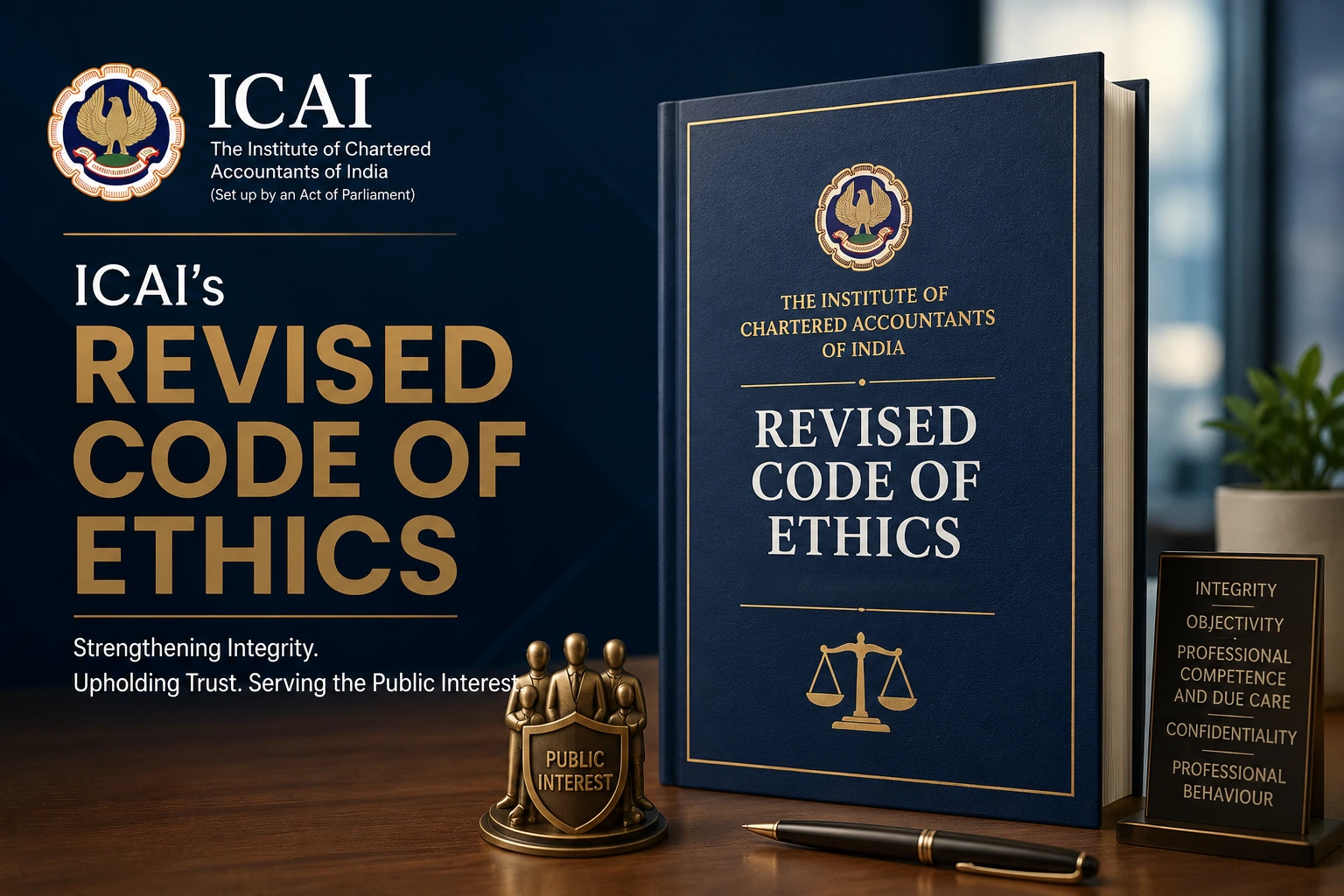
ICAI Just Rewrote the Rulebook for Every Chartered Accountant in India
The revised Code of Ethics (13th Edition) is now live — and it’s bigger than most people realise. Here’s everything you need to know.
On May 30, 2026, the Ethical Standards Board of the Institute of Chartered Accountants of India (ICAI) formally announced the applicability of the revised Code of Ethics — 13th Edition. The code, which comes in three volumes, became effective from April 1, 2026, and covers everything from professional conduct and independence standards to a brand-new framework for sustainability assurance.
This isn’t a cosmetic update. It is the most comprehensive overhaul of the ICAI Code since the 12th Edition in 2020 — and in several ways, it marks a genuine inflection point for the Indian CA profession.
“This is a full reset — not just a revision. Three volumes. New independence standards. Global convergence. And a dedicated sustainability ethics framework that India’s profession has never had before.”
TaxRoutine Analysis
The Three Volumes, Decoded
The revised Code is structured across three distinct volumes — each serving a separate purpose and audience within the profession.
Why the IESBA Convergence Matters
Volume II’s convergence with the IESBA Code 2024 is significant for any CA working with multinational clients, foreign subsidiaries, or cross-border assurance engagements. The International Ethics Standards Board for Accountants is the global ethics standard-setting body under IFAC, and its 2024 edition introduced a more structured approach to identifying and addressing threats to ethical compliance.
The revised framework strengthens independence requirements for auditors and mandates transparency in engagements involving emerging areas like technology-driven services and sustainability disclosures. It also provides enhanced clarity on applying independence principles in complex, multi-entity business environments — something that increasingly comes up in practice.
Volume III: The Sustainability Chapter Nobody Is Talking About
If one part of the 13th Edition deserves more attention than it’s getting, it’s Volume III.
For the first time, ICAI has introduced a dedicated ethics framework for sustainability assurance — covering the full scope of what CAs are increasingly being asked to do in the ESG and non-financial reporting space. This includes:
- ESG Reporting — Environmental, Social, and Governance disclosures for listed entities
- Business Responsibility and Sustainability Reporting (BRSR) — Mandatory for top-listed companies under SEBI
- CSR Impact Assessment — Evaluating the outcomes of corporate social responsibility spends
- Social Impact Assessments — Broader social outcome evaluations beyond traditional financials
- Independence Standards — Specific norms governing auditor independence in sustainability assurance engagements
This isn’t just regulatory box-ticking. As SEBI’s BRSR Core framework matures and sustainability assurance moves from voluntary to mandatory for an expanding set of companies, Volume III sets the ethical guardrails for a rapidly growing practice area. CAs entering this space without understanding its independence and ethics norms do so at significant risk.
Advertising and Website Rules: A Historic Shift
One change that generated considerable attention across the profession is the revision to advertising and website guidelines. For the first time in decades, ICAI has formally recognised that the professional communication landscape has changed — and has updated the rules accordingly.
Under the revised Code, CA firms now have greater flexibility in advertising content — including what ICAI describes as “contemporary forms” of write-ups, and expanded website functionality. Specifically, firms and members are now permitted to use push technology for services that are not exclusive to the CA profession — such as consultancy and accounting services — aligning with current digital practices.
Network firms registered with ICAI are also now permitted to develop and maintain their own websites — a meaningful change for mid-size and growing practices that operate as part of larger networks.
Global Networking: Opening Doors for Indian Firms
Alongside the Code revision, ICAI has issued updated guidelines enabling Indian CA firms, networks, and consultancy companies to form associations with international entities and pursue opportunities abroad. The stated goal is to offer Indian firms — particularly small and medium practices — access to international knowledge, technology, and expertise, enabling them to participate in cross-border collaborations.
Taken together with the IESBA convergence in Volume II, this signals a deliberate push to position Indian CAs as globally competitive professionals operating under internationally recognised ethical frameworks.
Key Dates: What Was When
2025
Serial No. (xxxi) — covering Social Impact, CSR Impact, BRSR assessments — made effective under Volume I. CAs in this space must comply from this date.
2025
ICAI’s 447th Council Meeting — approval of the revised 13th Edition and updated advertising and global networking guidelines announced.
2026
Revised Code of Ethics (13th Edition) — Volumes I, II and III — becomes fully effective for all ICAI members.
2026
ICAI’s Ethical Standards Board formally announces applicability and publishes access links for all three volumes on icai.org.
What Every CA Must Do Now
If you haven’t yet engaged with the revised Code, here’s a practical starting point:
- Download all three volumes from icai.org — each volume is accessible via dedicated links on the ICAI website.
- If you handle ESG, BRSR, or CSR impact work, read Volume III carefully — and check your independence compliance retroactively from December 11, 2025.
- If you have international clients or work with foreign entities, review Volume II’s IESBA-aligned independence standards — your existing engagement letters may need updating.
- Review your firm’s website and digital communications against the new advertising guidelines — especially if you use newsletters, notifications, or push content.
- If you’re part of a network firm, ensure your firm’s website is compliant with the new permissions and any remaining restrictions.
- Stay alert for further ICAI guidance — the full detailed wording of certain advertising provisions is expected to be notified separately.
References & Sources
- ICAI Ethical Standards Board — Applicability of Revised Code of Ethics (13th Edition), May 30, 2026
- TaxScan — ICAI Releases Updated Code of Ethics, May 2026
- CA Club India — ICAI Releases Revised Code of Ethics 2026, May 2026
- StudyCafe — ICAI Revises Code of Ethics (13th Edition), May 2026
- The Accountant / GlobalData — ICAI Amends Code of Ethics and Advertising Guidelines, December 2025
- BestMediaInfo — ICAI Updates Code of Ethics, Easing Advertising Rules, December 2025
- IndiaFilings — ICAI CA Firm Advertisement Guidelines 2026
- IESBA — International Code of Ethics for Professional Accountants (2024 Edition)
- ICGN Comment Letter — ICGN Response to ICAI Exposure Draft (13th Edition), November 2025