
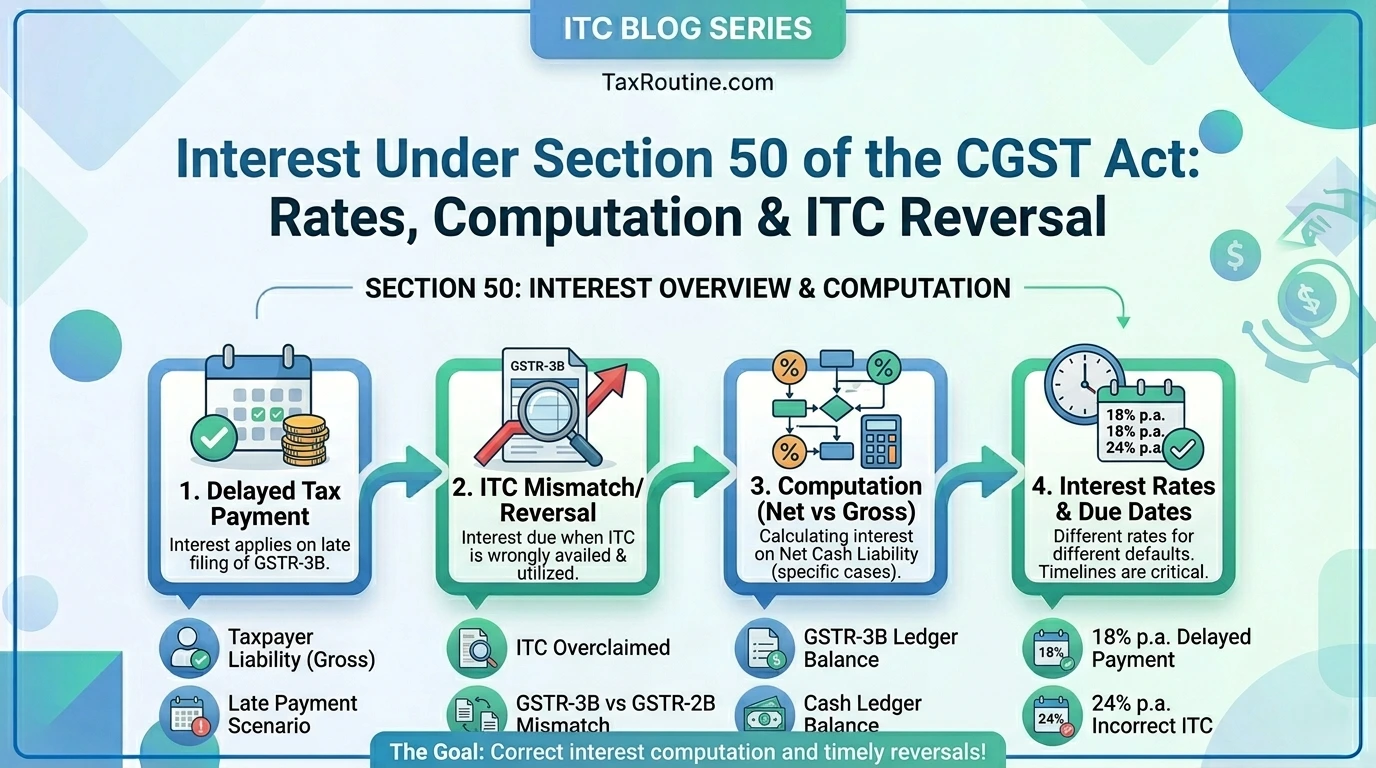
Interest Under Section 50
of the CGST Act
When does interest run, at what rate, on what base — and how does the net cash liability amendment change everything? The complete picture.
- Part 1 — What is Input Tax Credit? A Plain-English Guide
- Part 2 — Section 16: Conditions for Claiming ITC
- Part 3 — Blocked Credits under Section 17(5)
- ▶ Part 4 — Interest under Section 50 (You are here)
- Part 5 — ITC on Capital Goods
- Part 6 — ITC Reversal under Rule 37: Practical Difficulties
- Part 7 — Input Service Distributors (ISD) under GST
📌 At a Glance
- Section 50 of the CGST Act imposes interest on delayed tax payment (18% p.a.) and on excess ITC claims / output tax reduction (24% p.a.).
- Interest runs from the day after the due date of filing GSTR-3B to the date of actual payment.
- The Finance Act 2021 amendment (effective 1 June 2021) restricts Section 50(1) interest to the net cash tax liability — not gross output tax — for delayed GSTR-3B filing.
- Interest on ITC reversal under Rule 37 (180-day non-payment) is levied at 18%, not 24%.
- Section 50 interest is mandatory and non-waivable by an officer — only a government notification can reduce or waive it.
- Interest liability arises automatically by operation of law — no notice or demand is required for it to accrue.
1. What is Section 50 of the CGST Act?
Section 50 of the CGST Act, 2017 is the provision that imposes interest liability on a registered person who fails to discharge their GST obligations on time. It operates as an automatic, statutory levy — interest begins to accrue the moment a due date is missed or an excess credit is availed, without any requirement for a demand notice from the department.
The provision has two distinct sub-sections, each covering a different trigger and carrying a different rate:
Every person who is liable to pay tax in accordance with the provisions of this Act or the rules made thereunder, but fails to pay the tax or any part thereof to the Government within the period prescribed, shall for the period for which the tax or any part thereof remains unpaid, pay, on his own, interest at such rate, not exceeding eighteen per cent., as may be notified by the Government… — Full text on CBIC.gov.in →
2. Section 50(1): Interest on Delayed Tax Payment
2.1 When Does It Trigger?
Interest under Section 50(1) is triggered whenever a registered person fails to pay tax by the due date. In practical terms, this means filing GSTR-3B after the due date and paying the net tax liability late. Due dates are prescribed under Section 39 of the CGST Act and vary based on turnover and filing frequency. Returns are filed through the GST portal at gst.gov.in.
| Taxpayer Category | GSTR-3B Due Date | Interest Starts From |
|---|---|---|
| Monthly filers (turnover > ₹5 Cr) | 20th of the following month | 21st of the following month |
| Quarterly filers — Category A states (QRMP) | 22nd of month following quarter | 23rd of month following quarter |
| Quarterly filers — Category B states (QRMP) | 24th of month following quarter | 25th of month following quarter |
2.2 The Interest Formula
Where: Tax Amount = Net cash tax liability (post-amendment, w.e.f. 01 June 2021)
Number of Days = From the day after the due date to the date of actual payment (both inclusive per CBIC practice)
Monthly filer misses the 20th July 2025 due date for June 2025 return
Output tax liability (CGST + SGST): ₹5,00,000
ITC available in electronic credit ledger: ₹3,50,000
Net cash tax payable: ₹5,00,000 − ₹3,50,000 = ₹1,50,000
GSTR-3B actually filed and tax paid: 5th August 2025
Days delayed: 21st July to 5th August = 16 days
Interest (post-amendment, on net cash):
₹1,50,000 × 18% ÷ 365 × 16 = ₹1,183 interest payable
Interest (pre-amendment method, on gross — for comparison):
₹5,00,000 × 18% ÷ 365 × 16 = ₹3,945 (the old, harsher computation)
The amendment saves this taxpayer ₹2,762 in interest on this single delayed return.
3. The Game-Changer: Net Cash Liability Amendment (Finance Act 2021)
Prior to the Finance Act 2021, Section 50(1) was widely interpreted — and enforced by the department — to levy interest on the gross output tax liability, regardless of the ITC balance sitting in the credit ledger. The Finance Act 2021 amended Section 50(1) by inserting a proviso, effective 1 June 2021, restricting interest to the net cash tax liability.
- Interest on gross output tax liability
- ITC balance in ledger gave no relief on interest
- Harsh on businesses with large ITC balances that filed late
- Disputes and writ petitions filed across multiple High Courts
- Interest on net cash tax liability only
- ITC available in credit ledger reduces the interest base
- Significant relief — interest only on what is paid in cash
- Prospective from 1 June 2021; retrospective applicability debated in courts
The amendment is worded as prospective (from 1 June 2021). However, the GST Council had recommended the change in its 39th Meeting (March 2020) with the intent that it be applied retrospectively from 1 July 2017. Multiple High Courts — including Telangana, Rajasthan, and Madras — have ruled in favour of taxpayers, applying the net cash basis even for periods before 1 June 2021. The matter is sub-judice at the Supreme Court level. Businesses with demands for pre-June 2021 interest on gross liability should seek legal advice.
The net cash liability proviso applies only to Section 50(1) — delayed filing of GSTR-3B. It does not apply to Section 50(3) (wrongful ITC at 24%), nor where fraud, suppression, or wilful misstatement is established. In such cases, interest continues to be levied on the full tax amount. For the full context on blocked credits under Section 17(5) that attract 24% interest, see Part 3 of this series.
4. Section 50(3): Interest on Wrongful ITC Claims at 24%
Section 50(3) targets a more serious category of default — where a registered person has claimed ITC in excess of what is permissible, or has reduced output tax liability beyond what is allowed. The penal rate of 24% per annum reflects the seriousness of this violation.
4.1 What Triggers Section 50(3)?
| Trigger | Example | Rate |
|---|---|---|
| Excess ITC claimed beyond GSTR-2B entitlement | Claiming ₹2,00,000 ITC when GSTR-2B shows only ₹1,50,000 | 24% p.a. |
| ITC claimed on blocked credit items (Section 17(5)) | Claiming ITC on company car purchase | 24% p.a. |
| ITC claimed without valid invoice or receipt of goods | Fake invoice / round-tripping transactions | 24% p.a. |
| Excess reduction in output tax liability | Incorrectly applying credit notes beyond permissible limits | 24% p.a. |
| ITC claimed after the Section 16(4) time limit | Claiming FY 2023-24 invoice ITC in January 2026 GSTR-3B | 24% p.a. |
4.2 From Which Date Does Section 50(3) Interest Run?
Interest under Section 50(3) runs from the date the excess ITC was availed — i.e., from the date of the GSTR-3B in which the incorrect claim was made — until the date the excess ITC is reversed or the tax is paid.
Where: Number of Days = From date of GSTR-3B in which wrong ITC was claimed → to date of reversal
Business claims ITC on a car purchase (blocked under Section 17(5)(a))
Date of wrongful ITC claim: GSTR-3B for October 2025 filed 20 November 2025. ITC wrongly claimed: ₹2,88,000 (GST on a ₹16,00,000 SUV at 18%).
Error identified during GST audit: March 2026. Reversal made in March 2026 GSTR-3B.
Days interest runs: 20 November 2025 to 20 March 2026 = 121 days
Interest u/s 50(3) at 24%:
₹2,88,000 × 24% ÷ 365 × 121 = ₹22,876 interest payable
Additionally, the wrongful claim may attract a penalty under Section 73 or 74 — 10% of tax for non-fraud cases, up to 100% for fraud.
5. Interest on ITC Reversal: Which Rate Applies?
A common source of confusion is the applicable interest rate when ITC has to be reversed. The rate depends on the reason for reversal. For the full Rule 37 reversal mechanics including practical difficulties, see Part 6 of this series.
| Reason for ITC Reversal | Interest Rate | Section | Basis |
|---|---|---|---|
| Non-payment to supplier within 180 days (Rule 37) | 18% p.a. | Section 50(1) | Treated as delayed tax payment, not wrongful claim |
| Supplier did not file return / pay tax (Rule 37A) | 18% p.a. | Section 50(1) | Reversal treated as delayed payment scenario |
| ITC on blocked credit items (Section 17(5)) | 24% p.a. | Section 50(3) | Wrongful / excess ITC claim |
| Excess ITC claimed beyond GSTR-2B entitlement | 24% p.a. | Section 50(3) | Wrongful claim — excess over permissible ITC |
| Rule 42 / 43 reversal — capital goods mixed use (if delayed) | 18% p.a. | Section 50(1) | No interest if reversed within time; 18% if delayed |
| ITC claimed after Section 16(4) time limit | 24% p.a. | Section 50(3) | Ineligible ITC claimed beyond statutory window |
| Re-claim of ITC after making payment post 180-day reversal | Nil | — | ITC re-credited; no fresh interest on re-credit |
The 180-day Rule 37 reversal attracts 18%, not 24%, because the law treats non-payment to a supplier as a form of delayed tax payment. The 24% rate is reserved for ITC that was never legally available in the first place — blocked credits, fictitious invoices, or claims beyond GSTR-2B entitlement.
6. How Interest Accrues: A Step-by-Step Timeline
Interest under Section 50 can only be paid in cash — through the electronic cash ledger on the GST portal. It cannot be discharged using the ITC balance in the electronic credit ledger. This applies to both 18% interest on delayed payment and 24% interest on wrongful ITC claims.
7. Self-Assessment and Voluntary Payment of Interest
Section 50 operates on a self-assessment basis. The law expects the registered person to compute and pay interest on their own, without waiting for the department to raise a demand. GSTR-3B filed late automatically triggers interest, and the GST portal now provides a system-computed interest amount which the taxpayer is expected to verify and pay.
How to Pay Interest in GSTR-3B
| Step | Action |
|---|---|
| 1 | Open GSTR-3B for the delayed period on the GST portal |
| 2 | Navigate to Table 5.1 — Interest and Late Fee payable |
| 3 | Verify the system-computed interest amount (or manually compute using the formula) |
| 4 | Ensure sufficient balance in the electronic cash ledger — interest cannot be paid from credit ledger |
| 5 | Pay the interest through Form GST PMT-06 (challan) before or at the time of filing GSTR-3B |
8. Can GST Interest Be Waived?
Section 50 interest is a mandatory statutory levy. An assessing officer or appellate authority does not have the discretion to waive or reduce it. Only the Government of India, through a notification under the GST Act, can reduce or waive interest. Check the CBIC website for current notifications on interest relief.
| Scenario | Waiver Possible? | Authority |
|---|---|---|
| Interest u/s 50 on delayed GSTR-3B | No — mandatory | Only Central Government via notification |
| COVID-19 relief (Notifications in 2020–2021) | Yes — notified | Central Government notification — specific periods waived |
| Penalty u/s 73 / 74 | Yes — on cause | Officer / Appellate authority with conditions |
| Late fee u/s 47 | Yes — by notification | Central Government; periodic waivers have been notified |
9. Interest vs Penalty: What’s the Difference?
| Parameter | Interest (Section 50) | Penalty (Sections 73 / 74) |
|---|---|---|
| Nature | Compensation to the government for time-value of money | Punitive — for contravention of law |
| Intent required? | No — purely based on delay or excess claim | Relevant — different rates for fraud vs non-fraud |
| Rate | 18% or 24% p.a. (fixed by law) | 10% (s.73) to 100% (s.74) of tax amount |
| Can be waived? | Only by government notification | Yes — officer has discretion; waived if tax + interest paid before SCN |
| Mode of payment | Cash only — electronic cash ledger | Cash only — electronic cash ledger |
| Accrues automatically? | Yes — by operation of law | No — requires adjudication (SCN → Order) |
| Reduced if paid early? | No — runs until payment date | Yes — nil penalty if paid before SCN (s.73); 25% if paid within 30 days of order |
10. Quick Reference: Section 50 at a Glance
| Situation | Rate | Basis | From / To |
|---|---|---|---|
| Delayed GSTR-3B filing / late tax payment | 18% p.a. | Net cash tax liability (post 1 June 2021) | Day after due date → date of payment |
| Excess ITC claimed (beyond GSTR-2B) | 24% p.a. | Full excess ITC amount | Date of wrong claim → date of reversal |
| ITC on blocked credits (Section 17(5)) | 24% p.a. | Full blocked ITC amount | Date of wrong claim → date of reversal |
| ITC not reversed after 180 days (Rule 37) | 18% p.a. | ITC amount reversed | Date ITC was claimed → date of reversal |
| ITC claimed after Section 16(4) deadline | 24% p.a. | Full time-barred ITC amount | Date of wrong claim → date of reversal |
| Rule 42 / 43 reversal — mixed-use capital goods (if delayed) | 18% p.a. | Unreversed proportionate ITC | Month of liability → date of reversal |
| Interest payment mode | Cash only — electronic cash ledger via gst.gov.in; ITC cannot be used to pay interest | ||
Frequently Asked Questions
- Part 1 — What is Input Tax Credit? A Plain-English Guide
- Part 2 — Section 16: Conditions for Claiming ITC
- Part 3 — Blocked Credits under Section 17(5)
- ▶ Part 4 — Interest under Section 50 (You are here)
- Part 5 — ITC on Capital Goods
- Part 6 — ITC Reversal under Rule 37: Practical Difficulties
- Part 7 — Input Service Distributors (ISD) under GST