
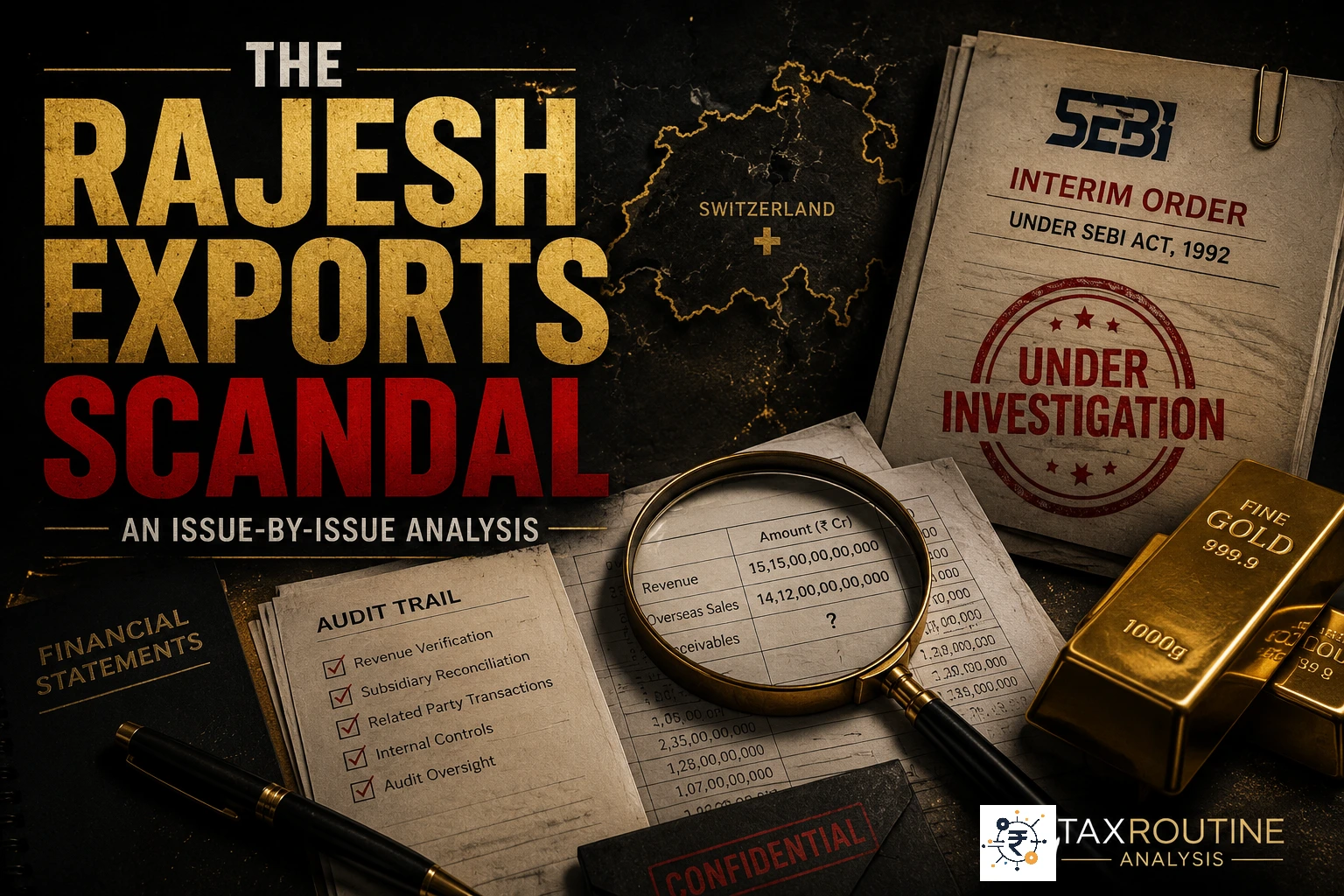
The Rajesh Exports Limited Scandal:
An Issue-by-Issue Reckoning
How a single shareholder’s email in 2024 unravelled what SEBI calls one of the largest alleged accounting frauds in Indian corporate history — ₹15.15 lakh crore in possibly fabricated revenues, diverted funds, phantom gold mines, and a Swiss refinery at the centre of it all.
On the evening of 3 June 2026, a 109-page document landed on the SEBI website. Written in the measured language of a regulatory order, it described what the regulator called “egregious” conduct — a systematic misrepresentation of revenue running to ₹15.15 lakh crore, spread across five financial years, orchestrated through overseas subsidiaries that were largely invisible to Indian investors. The accused: Rajesh Exports Limited, a Bengaluru-headquartered gold company once celebrated as a homegrown champion, and its promoter-chairman Rajesh Mehta. Both were immediately barred from the securities market. By the next morning, the stock had hit its 5% lower circuit with no buyers on either exchange.
The case did not begin with a whistleblower or a journalist or a short-seller’s report. It began with one shareholder’s email — filed on 11 March 2024 — raising a seemingly technical concern about overdue trade receivables. What that complaint triggered was a two-year investigation that eventually reached Switzerland, Africa, and an EV company registered in India. Below is an exhaustive, issue-by-issue analysis of every allegation SEBI has levelled.
The central allegation in SEBI’s interim order is staggering in scale. Between FY2020-21 and FY2024-25, Rajesh Exports Limited reported consolidated revenues that placed it among India’s highest revenue-generating listed companies — a distinction that long puzzled market observers given its relatively modest market capitalisation of roughly ₹3,210 crore as of early June 2026. SEBI’s forensic investigation, conducted by audit firm BDO, concluded that approximately ₹15.15 lakh crore — or 99.80% of the revenues attributed to overseas subsidiaries over those five years — cannot be substantiated by documentary evidence.
The mechanism alleged is sophisticated. Rajesh Exports’ structure meant that between 97% and 99% of its consolidated revenues were generated not by the Indian parent company but by overseas subsidiaries, primarily through Valcambi SA, its Switzerland-based gold refinery. Because Valcambi and the intermediate holding entity Global Gold Refineries AG (GGR) operated outside India, their standalone financials were neither audited by Indian firms nor consistently disclosed in the public domain under Indian listing regulations. This opacity, SEBI argues, was not incidental — it was structural.
“The standalone revenues of Valcambi SA constituted less than 0.50% of the consolidated revenues reported by GGR and REL, which appears fundamentally inconsistent with REL’s repeated assertion that Valcambi SA was the principal operating entity driving the group’s revenues.”
— SEBI Interim Order, June 3, 2026SEBI’s Whole-Time Member Kamlesh Chandra Varshney noted that when investigators tried to reconcile the consolidated revenue figures with available subsidiary-level records, no satisfactory match could be found. The parent’s accounts showed enormous turnover; the subsidiary accounts — to the extent they could be obtained — did not support those figures. The forensic auditor, BDO, was ultimately able to verify only 35.07% of sales samples (worth ₹12,217 crore) with complete documentation. The remaining documentation was either withheld or unavailable.
- 97–99% of consolidated revenue traced to overseas subsidiaries that filed minimal standalone disclosures
- Valcambi SA, presented as the principal revenue engine, showed standalone revenues of less than 0.5% of REL’s consolidated figures
- BDO could verify only 35.07% of sampled sales with complete documentation
- The alleged misrepresentation represents 99.80% of all revenue attributable to subsidiaries over five years
The company’s response — filed with BSE on 4 June 2026 — stated that “the revenues declared by the company are correct, and there is no over-stating of revenues,” attributing the discrepancy to “some type of communication gap and confusion.” Promoter Rajesh Mehta was more blunt: “It is an interim order and nothing in it is true.” However, SEBI’s order noted that even as of the date of the order, the company had not furnished the documentary evidence needed to bridge the gap between the parent’s consolidated figures and the subsidiary-level disclosures.
From a legal standpoint, this allegation — if proven — would constitute a violation of SEBI (Listing Obligations and Disclosure Requirements) Regulations, 2015, the SEBI (Prohibition of Fraudulent and Unfair Trade Practices) Regulations, and the Companies Act, 2013’s provisions on preparation of true and fair financial statements. The referral to the National Financial Reporting Authority (NFRA) to examine the company’s statutory auditors signals that SEBI believes these numbers should have been caught and queried long before 2024.
Deep Dive · Now Live Watchdog, Not a Bloodhound — But How Far Does That Defence Go? How far does the 130-year-old Kingston Cotton Mill principle stretch against SA 240, Section 143(12), and NFRA’s explicit repudiation? Read the full analysis. →Rajesh Exports’ acquisition of Valcambi SA in 2015 for $400 million (approximately ₹2,560 crore at the time) was widely celebrated as a landmark moment for Indian corporate ambition. Valcambi, headquartered in Balerna, Switzerland, is one of the world’s foremost precious metals refineries, processing over 900 tonnes of gold annually for central banks, bullion markets, and mining companies worldwide. Acquiring it seemed to guarantee Rajesh Exports both backward integration and a powerful global brand.
The Valcambi acquisition also created the structural opacity that now sits at the heart of SEBI’s case. The ownership chain works as follows: Rajesh Exports (Indian listed parent) → Singapore holding subsidiary → Global Gold Refineries AG (GGR), a Swiss holding company → Valcambi SA, the operating refinery. This multi-layer structure meant that the revenues from Valcambi were consolidated upward through GGR into REL’s accounts, but none of the intermediate entities were subject to Indian disclosure requirements.
When the company reported consolidated revenues of ₹2.81 lakh crore in a single year, investors — and regulators — were expected to take on trust that a gold refinery in rural Switzerland had generated transaction volumes on a par with India’s largest public sector banks.
SEBI’s investigation found a critical discrepancy. Rajesh Exports consistently represented Valcambi as its “principal operating entity.” Yet when forensic auditors examined the standalone revenues actually audited and filed by Valcambi SA in Switzerland, the numbers were a fraction — less than 0.5% — of what the Indian parent attributed to the group in consolidated accounts. The company attempted to explain this by arguing that Valcambi recognised only processing income (a fee-based revenue) while GGR, the holding entity, recognised the gross value of gold transactions flowing through the chain. SEBI found this explanation “not backed by sufficient documentary evidence” and remained unconvinced at the interim stage.
- Valcambi SA’s standalone Swiss filings showed revenue less than 0.5% of REL’s consolidated revenue attributable to the group
- GGR reported consolidated revenue of ₹2.93 lakh crore vs. Valcambi’s standalone figures — a vast, unexplained gap
- Company’s “processing income vs. gross transaction value” explanation found insufficient by SEBI
- No audited subsidiary financials were consistently placed in the public domain for Indian investors to verify
This issue is analytically distinct from outright fabrication. It is possible that gold bullion trades of enormous value passed through GGR’s books at gross transaction value, giving rise to the headline revenues without any equivalent economic activity at the standalone Valcambi level. What SEBI argues is that if that is the explanation, REL should have disclosed this clearly, consistently, and with supporting documentation — and it did not. The failure to do so misled investors into believing the company generated genuine commercial revenues commensurate with its reported turnover. This is the disclosure failure dimension of the case, as distinct from potential outright fabrication examined in Issue 3 below.
A collateral consequence of the Valcambi situation is international. Should regulatory proceedings escalate, Valcambi’s operations — which supply gold bars held in central bank reserves globally — could face uncertainty. The Swiss refinery itself is not accused of any wrongdoing; the issue is entirely about how its revenues were characterised by its Indian parent.
Deep Dive · Coming This Week Can SEBI’s LODR Regulations Catch Offshore Subsidiaries? How Regulation 33 created a structural blind spot for listed Indian companies with overseas operating entities — and what reform must follow. →If the Valcambi issue involves contested accounting methodologies, the Affluence Shares allegation involves something far more categorical: transactions that, according to the counterparty itself, never happened at all.
Rajesh Exports’ books record sales of ₹114.87 billion and purchases of ₹114.88 billion with a company called Affluence Shares and Stocks Private Limited — a closely matched pair of figures that by themselves look unusual (genuine commodity trades rarely net out so perfectly at this scale). More damaging is what Affluence told SEBI directly: that no such transactions ever took place between the two entities. The company denied any business relationship with Rajesh Exports of the magnitude claimed.
SEBI’s working theory is that these entries were fabricated accounting records — not to embezzle money, but to manufacture the appearance of commercial scale. The alleged purpose: to inflate reported turnover as a smokescreen for Rajesh Mehta’s personal derivatives trading activity.
SEBI’s investigation reportedly found that funds transferred under the guise of these transactions were actually connected to Mehta’s personal derivatives positions in the securities market. In other words, the allegation is that the listed company’s books were used to process and legitimise the promoter’s personal trading — a serious misuse of corporate resources and a potential violation of the prohibition on insider benefits and related-party irregularities under both SEBI regulations and the Companies Act.
- ₹114.87 billion in purported sales with Affluence Shares — denied entirely by Affluence
- Symmetrical purchase figure of ₹114.88 billion — suggesting circular or round-trip accounting
- SEBI alleges entries were fabricated to inflate turnover and mask promoter derivatives activity
- If confirmed, would constitute fraud under SEBI (PFUTP) Regulations, 2003
The implications here are qualitatively different from the Valcambi issue. While the Valcambi dispute is, at least in part, an argument about accounting standards and consolidation methodology, the Affluence allegation — if proven — is simply fraud: recording transactions that all parties agree did not occur. It would represent a deliberate manipulation of the company’s financial statements to deceive shareholders, analysts, and regulators.
Mehta’s denial that anything improper occurred will need to be examined in the full proceedings. SEBI has, at this stage, only made prima facie observations. But the regulator’s ability to produce Affluence’s own denial of the transactions — a statement from the purported counterparty — is a particularly strong piece of preliminary evidence that will be difficult to rebut without contemporaneous transaction records.
Deep Dive · Coming This Week Revenue Recognition: What Ind AS 115 Says and How REL May Have Deviated The principal vs. agent distinction, gross vs. net presentation, and the disclosure obligations the company allegedly ignored. →Beyond inflated revenues, SEBI alleges that Rajesh Exports actively transferred company funds to Rajesh Mehta’s personal accounts — and that these funds were used for derivatives trading. The order records that ₹3.39 billion was transferred to Mehta’s personal accounts, with a total of ₹9.26 billion moved through related transactions without the required board approvals, audit committee oversight, or investor disclosures mandated under SEBI’s listing regulations and the Companies Act.
The company’s own correspondence, reviewed by SEBI during the investigation, reportedly contained admissions that funds were moved without disclosing the source account — an acknowledgment that, even internally, the transfers were understood to lack proper procedural sanction. The SEBI order also noted that MD Suresh Gowda confirmed to investigators that overseas subsidiaries and step-down subsidiaries were “exclusively handled” by Mehta, meaning any fund flows at that level were within his direct control and without meaningful board oversight.
The combination of inflated revenues, phantom transactions, and fund transfers to a promoter’s personal trading accounts draws a direct line between alleged accounting fraud and personal financial benefit — the classic triangle of motive, means, and opportunity.
A second, distinct fund-diversion issue involves Elest Private Limited, a promoter-linked electric vehicle company. SEBI found that Rajesh Exports had made investments in ACC Energy Storage, an EV battery firm, and that a subsequent cross-holding arrangement with Elest — substantially owned and controlled by Mehta — resulted in approximately 48.95% of ACC Energy’s ownership being transferred to Elest. SEBI argued that this arrangement amounted to diluting Rajesh Exports’ stake in a company it had invested in and routing the economic benefit to a promoter-controlled entity — without adequate shareholder approvals or disclosures.
- ₹3.39 billion transferred to Mehta’s personal accounts, allegedly used for derivatives trading
- ₹9.26 billion total moved through related transactions without required approvals
- Cross-holding with Elest Pvt Ltd resulted in 48.95% of ACC Energy being effectively transferred to promoter entity
- No board approval, audit committee review, or investor disclosure for the above transactions
- Company admitted in its own correspondence that fund movements occurred without source-account disclosure
The Elest-ACC Energy structure illustrates how complex multi-entity arrangements can obscure what are, in essence, related-party transactions that benefit promoters at the expense of minority shareholders. Under Indian corporate governance norms, any transaction involving promoter-related entities requires explicit board approval and, above certain thresholds, shareholder approval. SEBI’s position is that none of these safeguards were applied. The referral to the exchanges and the summons that followed in March 2026 were, the regulator says, met with vague and evasive responses from the company.
Deep Dive · Coming This Week Related Party Transactions: Where Did the Framework Break Down? Section 188, SEBI’s RPT Circular of 2021, and the Elest-ACC Energy cross-holding — a step-by-step examination of how every safeguard was allegedly bypassed. →In addition to contested revenues, SEBI flagged a significant discrepancy in the company’s asset disclosures. Rajesh Exports claimed investments totalling ₹1,035.27 crore in gold mining assets located in Africa. When SEBI sought documentation to substantiate these investments — title documents, mine surveys, ownership records — the response from the company was what the regulator described as “vague, unsupported and incapable of verification.”
In one exchange, Rajesh Exports told SEBI that it was “unable to locate its earlier response furnished to the exchange due to absence of date details” — a response that the regulator characterised as evasive. The company also stated that the investments “existed through foreign subsidiaries” and that the figures were “tallying and correct,” but provided no independent documentation that could verify either the existence of the mines or the valuation attributed to them.
A company that has claimed to be one of the world’s leading gold companies for three decades was unable to provide basic documentary evidence that it owns gold mines it values at over a thousand crore rupees. That is not a communication gap. It is a foundational governance problem.
The gold mining claim connects to the original 2015 narrative around the Valcambi acquisition. When Rajesh Exports bought Valcambi, its MD Prashant Mehta publicly stated that the acquisition was “the first step towards venturing into mining.” Investors were encouraged to see the company as pursuing a vertically integrated model from mine to market. If the African mining investments turn out to be unverifiable or nonexistent, that narrative was at best aspirational and at worst misleading.
- ₹1,035.27 crore claimed as investments in African gold mining assets
- SEBI found the explanation “vague, unsupported and incapable of verification”
- Company’s response — “unable to locate earlier response” — found inadequate
- No title deeds, mining rights, or independent valuations produced to substantiate claims
- If unverifiable, inflates the asset base disclosed to investors and lenders
From a regulatory standpoint, disclosing material assets that cannot be verified independently is a significant breach of the continuous disclosure obligations under SEBI LODR Regulations. If lenders — banks reportedly have “considerable exposure” to the company according to Congress leader Jairam Ramesh, who raised questions in the political arena — relied on these asset disclosures for credit assessments, the implications extend well beyond securities regulation into banking prudential concerns.
Series · In Analysis The Full Rajesh Exports Investigation Series Eight deep-dive posts are in preparation — covering audit standards, revenue recognition, governance failures, and regulatory reform. Notify me when each goes live. →Perhaps the most troubling dimension of the Rajesh Exports case is not what allegedly happened, but how it allegedly went undetected — and unquestioned — for so long. Multiple layers of the corporate governance system appear to have failed simultaneously, and SEBI’s interim order makes no effort to conceal its frustration with each of them.
Obstruction of the forensic audit. BDO, appointed by SEBI as forensic auditor, was denied access to the company’s ERP systems, books of accounts, and journal dump. It is a striking fact: a regulator-appointed forensic auditor, tasked with examining a listed company’s records, could not get basic accounting access. As a result, BDO could verify only 35.07% of the sales samples it examined. The SEBI order directed REL and Mehta to cooperate with the investigation and furnish all required documents within 30 days — an indication that as of the order date, that cooperation had not been forthcoming.
When a forensic auditor appointed by the securities regulator cannot access a company’s accounting systems, the governance failure has moved beyond negligence. It becomes active resistance to accountability.
Statutory auditors under scrutiny. SEBI has referred the matter to the National Financial Reporting Authority (NFRA) specifically to examine the conduct of Rajesh Exports’ statutory auditors. The implication is that professional auditors — who signed off on the company’s financial statements year after year — either failed to exercise sufficient professional scepticism or faced access limitations similar to those encountered by BDO. NFRA proceedings, if initiated, could result in penalties, suspension, or deregistration of the audit firm involved.
LIC’s exposure and the institutional oversight question. Life Insurance Corporation of India holds 10.80% of Rajesh Exports — a stake held on behalf of millions of Indian policyholders. The political dimension was immediately seized upon by the Congress party, whose leader Jairam Ramesh publicly asked how LIC could have maintained such a substantial stake in a company where, he alleged, such a large fraud was taking place. LIC’s investment decision-making processes — and whether its internal governance teams raised concerns about the structural anomalies in REL’s revenue profile — will likely face scrutiny going forward.
- BDO denied ERP and books access — could verify only 35.07% of sales samples
- No board or audit committee approval for ₹9.26 billion in fund movements
- Statutory auditors referred to NFRA for examination of their role
- Overseas subsidiaries “exclusively handled” by promoter Mehta with no board oversight
- LIC holds 10.80% stake — raised questions about institutional due diligence
- Listing regulations on subsidiary financial disclosure apparently not enforced for years
The disclosure architecture problem. At a systemic level, the Rajesh Exports case exposes a gap in India’s listing regulations: a company whose revenues are almost entirely generated by overseas subsidiaries can, for years, present consolidated accounts without subjecting those subsidiaries to the same disclosure rigour applied to the Indian parent. The offshore structure — Singapore subsidiary → GGR Switzerland → Valcambi Switzerland — allowed enormous revenue figures to appear in consolidated accounts while the underlying entities remained opaque to Indian investors and regulators. Post this case, a regulatory review of subsidiary disclosure norms for listed Indian companies with offshore operating entities seems not just likely but inevitable.
What happens next. The interim order is precisely that — interim. Rajesh Exports and Mehta have the right to approach SEBI’s full bench for a hearing, present evidence, and contest every prima facie finding. If the investigation concludes with adverse findings, the case would move toward formal adjudication proceedings and potential penalties. Parallel proceedings may emerge before NFRA (for auditors), the Ministry of Corporate Affairs (for Companies Act violations), and potentially the Enforcement Directorate if money laundering provisions are invoked. The investigation remains open and the final chapter is yet to be written.
Deep Dives · Coming This Week Has the CS Role Become Clerical? · Audit Trail — Was It the Need of the Hour? · LIC as 10.8% Shareholder: What Were Its Duties? Three posts examining the governance architecture that failed — the Company Secretary’s structural disempowerment, MCA’s audit trail mandate and its enforcement gaps, and LIC’s institutional oversight obligations. →The Bigger Picture: What This Case Means for Indian Markets
The Rajesh Exports case, even in its interim stage, raises questions that extend far beyond one company and one promoter. For decades, the company occupied an unusual position in the Indian corporate landscape — among the highest revenue-generating listed entities, yet with a market capitalisation a fraction of its turnover. That paradox was visible to anyone who looked, yet it attracted no meaningful regulatory inquiry until a private shareholder wrote an email in March 2024.
If SEBI’s allegations are substantially confirmed through the full investigation, the case will stand as evidence that a company can misrepresent revenues at a scale of ₹15 lakh crore — larger than India’s annual defence budget many times over — for five consecutive years, through a combination of offshore opacity, sympathetic auditors, and a regulatory architecture that was not designed to interrogate overseas subsidiary accounts with sufficient rigour.
That is not just a story about Rajesh Exports. It is a stress test of India’s entire corporate governance framework. The outcome of the full proceedings — and SEBI’s response in terms of regulatory reform — will shape the credibility of India’s capital markets for years to come.
Rajesh Mehta’s position remains firm: “Nothing in it is true.” That dispute will now be settled in proceedings where documentary evidence, not assertions, will determine the outcome.
- 00The Rajesh Exports Scandal: An Issue-by-Issue ReckoningYou are here
- 01Watchdog, Not a Bloodhound — But How Far Does That Defence Go?Live
- 02Do Auditing Standards Actually Protect the Auditor of Rajesh Exports?Coming Soon
- 03Revenue Recognition: What Ind AS 115 Says and How REL May Have DeviatedComing Soon
- 04Has the Company Secretary Become a Clerical Post?Coming Soon
- 05Audit Trail — Was MCA’s Mandate the Need of the Hour?Coming Soon
- 06Can SEBI’s LODR Regulations Catch Offshore Subsidiaries?Coming Soon
- 07LIC as a 10.8% Shareholder: What Were Its Duties?Coming Soon
- 08Related Party Transactions: Where Did the Framework Break Down?Coming Soon