
ITC on Capital Goods Under GST:
Eligibility, Rules & Reversal
Full upfront credit, 5-year useful life, reversal on sale or mixed use — everything a business needs to know about capital goods ITC.
- Part 1 — What is Input Tax Credit? A Plain-English Guide
- Part 2 — Section 16: Conditions for Claiming ITC
- Part 3 — Blocked Credits under Section 17(5)
- Part 4 — Interest under Section 50 of the CGST Act
- ▶ Part 5 — ITC on Capital Goods (You are here)
- Part 6 — ITC Reversal under Rule 37: Practical Difficulties
- Part 7 — Input Service Distributors (ISD) under GST
📌 At a Glance
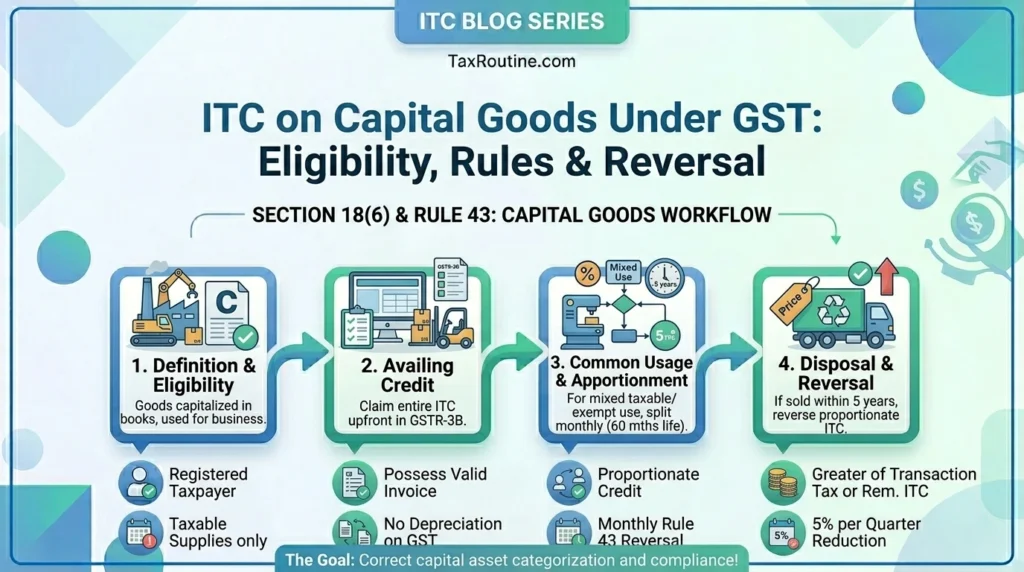
- Full ITC is available upfront on capital goods in the year of purchase — no spreading over years unlike the old CENVAT regime.
- Capital goods are defined as goods capitalised in the books of accounts under Section 2(19) of the CGST Act.
- Useful life for reversal purposes is prescribed as 60 months (5 years) under the CGST Rules.
- On sale of capital goods, pay the higher of: ITC proportionate to remaining life, or GST on transaction value.
- Capital goods used for both taxable and exempt supplies require monthly proportionate reversal under Rule 43.
- ITC is not available if depreciation on the GST component is claimed under the Income Tax Act — Section 16(3).
1. What Are Capital Goods Under GST?
Section 2(19) of the CGST Act, 2017 defines capital goods as goods whose value is capitalised in the books of accounts of the person claiming credit — and which are used or intended to be used in the course or furtherance of business.
This is a straightforward, books-based definition. If a purchase is capitalised as a fixed asset in your accounts, it is a capital good for GST purposes. If it is expensed directly to the P&L, it is an input, not a capital good, for Input Tax purposes.
| Item | Typically Classified As | ITC Category |
|---|---|---|
| Manufacturing machinery, lathes, CNC machines | Capitalised — Fixed Asset | Capital Goods |
| Computers, servers, laptops | Capitalised — Fixed Asset | Capital Goods |
| Vehicles (goods transport trucks) | Capitalised — Fixed Asset | Capital Goods (if ITC not blocked) |
| Office furniture and fittings | Capitalised — Fixed Asset | Capital Goods |
| Raw materials, consumables | Expensed — P&L | Inputs |
| Spare parts (revenue nature) | Expensed — P&L | Inputs |
| Spare parts (capitalised with machinery) | Capitalised — Fixed Asset | Capital Goods |
The GST classification of an item as a capital good or input depends entirely on how it is treated in the books of accounts — not on its physical nature. The same item (e.g., a power tool) could be an input if expensed and a capital good if capitalised. Businesses should ensure their accounting treatment is consistent and deliberate.
2. Eligibility: When Can ITC Be Claimed on Capital Goods?
ITC on capital goods is available subject to the same four conditions under Section 16(2) that apply to all Input Tax Credit (ITC) claims — valid invoice, receipt of goods, supplier payment of tax, and return filing by the recipient. Additionally, the following specific rules apply:
| Condition | Position Under GST |
|---|---|
| When can credit be taken? | In the tax period in which the capital good is received — full credit available immediately |
| Must credit be spread over useful life? | No — full upfront credit permitted (unlike pre-GST CENVAT) |
| Depreciation on GST component claimed under IT Act? | ITC not available — Section 16(3) bars double benefit |
| Capital good used only for taxable supplies? | Full ITC — no reversal required |
| Capital good used only for exempt supplies? | No ITC — or full reversal if already claimed |
| Capital good used for both taxable and exempt? | Proportionate — Rule 43 reversal required monthly |
| Capital good blocked under Section 17(5)? | No ITC — e.g., cars ≤13 seats, construction goods |
3. The 5-Year Useful Life Rule
While the input tax credit (ITC) on capital goods can be claimed in full upfront, the CGST Rules prescribe a deemed useful life of 60 months (5 years) for capital goods. This useful life figure is used exclusively for two reversal computations. It does not affect when the credit is taken.
4. ITC Reversal on Sale or Disposal of Capital Goods
When a registered person sells, transfers, or disposes of a capital good on which Input Tax has been claimed, they must reverse a portion of that Input Tax credit, proportionate to the remaining useful life of the asset. The reversal amount is compared against the GST on the transaction value, and the higher of the two must be paid. If the reversal is delayed beyond the required period, interest at 18% p.a. under Section 50 applies.
Months remaining in useful life (out of 60) = B
ITC attributable to remaining life = A × B ÷ 60
Amount to pay = Higher of (ITC × remaining months ÷ 60) OR (GST on transaction value of sale)
A manufacturer sells a CNC machine after 2 years of use
Original purchase: January 2023. Cost: ₹20,00,000 + GST at 18% = ₹3,60,000. ITC claimed: ₹3,60,000.
Sale date: January 2025 (exactly 24 months / 2 years used).
Sale price: ₹12,00,000 + GST at 18% = ₹2,16,000 collected from buyer.
Months remaining: 60 − 24 = 36 months
ITC reversal amount: ₹3,60,000 × 36 ÷ 60 = ₹2,16,000
GST on transaction value: ₹2,16,000
Higher of the two: Both equal at ₹2,16,000 → ₹2,16,000 must be reversed.
Same machine sold as scrap after 4.5 years (54 months)
Scrap value: ₹80,000 + GST at 18% = ₹14,400 output tax.
Months remaining: 60 − 54 = 6 months
ITC reversal (proportionate): ₹3,60,000 × 6 ÷ 60 = ₹36,000
GST on transaction value: ₹14,400
Higher of the two: ₹36,000 → Reverse ₹36,000 (not merely ₹14,400).
The business must reverse ₹36,000 even though it collected only ₹14,400 in output GST — the sting of scrapping assets before 5 years.
Once a capital good has completed its 60-month deemed useful life, the ITC is fully “consumed.” If the asset is sold after 5 years from the date of purchase, no ITC reversal is required — only the GST on the transaction value is payable as normal output tax.
5. Rule 43: ITC Apportionment for Mixed-Use Capital Goods
When capital goods are used for both taxable and exempt supplies, ITC cannot be claimed in full. Rule 43 of the CGST Rules prescribes a monthly apportionment mechanism. If the monthly reversal is not made on time, interest at 18% p.a. under Section 50(1) applies.
Step 2: Exempt supply ratio = Exempt turnover ÷ Total turnover for the month
Step 3: ITC to reverse for the month = Tc/m × Exempt ratio
Step 4: At year end — reconcile with annual exempt ratio; adjust in GSTR-9
A pharmaceutical company uses a packaging machine for both taxable and exempt medicines
Machine cost: ₹12,00,000 + GST at 18% = ₹2,16,000 ITC claimed upfront.
Monthly ITC (Tc/m): ₹2,16,000 ÷ 60 = ₹3,600 per month
April 2026 turnover: Taxable medicines ₹40,00,000 | Exempt medicines ₹10,00,000 | Total ₹50,00,000
Exempt ratio for April: ₹10,00,000 ÷ ₹50,00,000 = 20%
ITC to reverse for April: ₹3,600 × 20% = ₹720
This ₹720 is reversed in April’s GSTR-3B Table 4(B). This computation repeats every month for 60 months.
6. ITC on Capital Goods: New Registration & Switching from Composition
6.1 New GST Registration — Section 18(1)(a) & (b)
A person who obtains GST registration can claim Input Tax Credit on capital goods held in stock on the day immediately preceding the date of registration. However, the Input Tax is reduced by 5% per quarter or part thereof from the date of purchase to the date of registration. The claim must be made within 30 days of becoming eligible by filing Form GST ITC-01 on the GST portal.
Note: Part of a quarter counts as a full quarter for this reduction.
Business registers for GST 18 months after purchasing equipment
Equipment purchased: October 2024. GST paid: ₹1,80,000.
GST registration date: April 2026 (18 months later = 6 complete quarters).
Reduction: 5% × 6 quarters = 30%
ITC available: ₹1,80,000 × (1 − 30%) = ₹1,26,000
6.2 Switching from Composition to Regular Scheme — Section 18(1)(c)
When a composition taxpayer switches to the regular GST scheme, they can claim the Input Tax Credit on capital goods held at the time of switching — reduced by 5% per quarter from the date of purchase. The 30-day window and Form GST ITC-01 filing requirement apply equally here. This is covered in Part 2 of this series.
7. Capital Goods & the Depreciation vs ITC Choice
Section 16(3) of the CGST Act creates an important trade-off for businesses that capitalise goods and claim depreciation under the Income Tax Act, 1961. The rule is simple: you cannot have both.
| Option | GST Treatment | Income Tax Treatment | Better For |
|---|---|---|---|
| Claim full ITC | Full ITC on GST component | Depreciation on cost excluding GST (net cost) | Most businesses — ITC is immediate cash benefit |
| Claim full depreciation | No ITC on GST component | Depreciation on full cost including GST | Businesses where ITC is blocked under Section 17(5) |
For most registered businesses, claiming full Input Tax Credit (ITC) is superior. The GST Input Tax credit is an immediate, rupee-for-rupee cash saving. Depreciation on the GST amount merely reduces taxable income at the applicable income tax rate (25 – 30%) and only over the asset’s life. The only exception is where ITC is blocked under Section 17(5) — in that case, including GST in the depreciable cost at least recovers some value over time.
8. Common Mistakes in Capital Goods ITC
| Mistake | Consequence | How to Avoid |
|---|---|---|
| Claiming Input Tax on capital goods blocked under Section 17(5) (e.g., company cars) | Demand + 24% interest u/s 50(3) + penalty | Check Section 17(5) before claiming |
| Claiming depreciation on GST component AND ITC | Input Tax Credit (ITC) disallowed under Section 16(3); interest at 24% | Coordinate with accounts team — exclude GST from depreciable cost when ITC is claimed |
| Not reversing ITC proportionately when capital goods are used for exempt supplies | Excess ITC — 24% interest + demand | Implement monthly Rule 43 computation as part of GSTR-3B preparation |
| Reversing only GST on sale value — ignoring the “higher of” rule | Shortfall in reversal — treated as unpaid tax | Always compute both: proportionate ITC and GST on sale price; reverse the higher |
| Claiming ITC when capital goods received in instalments before full delivery | Premature credit — Section 16(2)(b) violated | ITC available only on receipt of last lot |
| Missing the 30-day window for Section 18(1) claims at new registration | Input Tax permanently lapsed | File GST ITC-01 on gst.gov.in within 30 days of becoming eligible |
Frequently Asked Questions
- Part 1 — What is Input Tax Credit? A Plain-English Guide
- Part 2 — Section 16: Conditions for Claiming ITC
- Part 3 — Blocked Credits under Section 17(5)
- Part 4 — Interest under Section 50 of the CGST Act
- ▶ Part 5 — ITC on Capital Goods (You are here)
- Part 6 — ITC Reversal under Rule 37: Practical Difficulties
- Part 7 — Input Service Distributors (ISD) under GST